Tag: Artificial intelligence

  • Attitudes Towards Generative AI: A Study with First-Year Computer Science Students

    Varvara Papazoglou is a Teaching Associate in the School of Computer Science, University of Sheffield. In this post Varvara shares the work she led to investigate student perceptions of AI that found growing confidence, excitement and acceptance. The work was presented at the 18th annual International Conference of Education, Research and Innovation (ICERI 2025).

    The study started during the academic year 2023-24 and was intended to track how the perceptions, expectations, and technical understanding of our undergraduate students shifted as they gained direct experience with GenAI technologies. With a team that included Alex Lucas and Prof. Rob Gaizauskas, we redesigned the first two lab sessions for a first-year module called Machines and Intelligence so that they included a practical introduction to Generative Artificial Intelligence (GenAI). Our study spanned two academic years, and tracked how the perceptions, expectations, and technical understanding of students shifted as they gained experience with GenAI technologies . To measure this, we invited volunteer participants from both cohorts to complete two online surveys, one before and one after engaging with the GenAI-focused curriculum of the module.
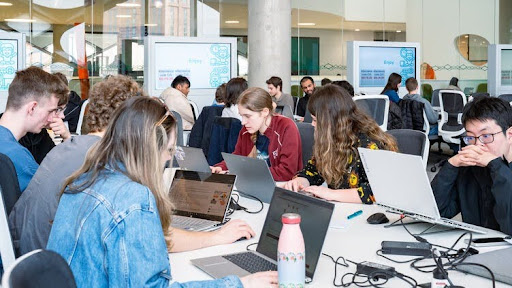
    Students on laptops in a classroom setting

    These questionnaires were administered three to four weeks apart, using unique IDs to match participant responses while preserving their anonymity. Structurally, they consisted of 13 core questions common to both iterations. Questions identified the specific GenAI tools students utilised and their typical purposes for doing so with, and 5-point Likert scales were used to evaluate viewpoints on GenAI’s performance, the identification of AI-generated content, and general feelings of excitement or concern. The perceived impact of AI on future careers, potential job obsolescence, and the ethics of GenAI use in university and workplace settings were explored. To ensure a comprehensive analysis, most of these questions included non-mandatory open-ended sections for qualitative insights, concluding with a final opportunity for participants to offer additional comments.

    Testing Turing

    The first lab focused on a practical adaptation of the Turing Test.
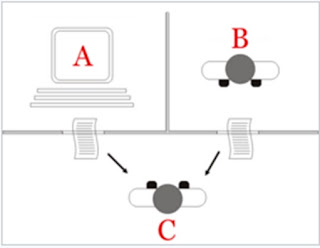
    Turing Test Diaghram

    Students were split into groups of 6-7, paired with another group to play the roles of “interrogator” (C in Turing’s original formulation) and “interrogated” (both A (the man) and B (the woman/machine)) interchangeably.

    To maintain anonymity and remove visual cues, all communication happened through a shared online document. The “interrogated” groups were tasked with choosing whether to provide the answers of an actual team member or to use ChatGPT or Gemini to produce human-like responses. The latter required students to act as prompt mediators; for example, they might instruct the model to adopt the persona of a 20-year-old first-year computer science student while keeping answers within a specific word count. This exercise forced students to grapple with the actual capabilities and flaws of these models. For their assessment, students submitted reflections on the following:

    ●      As interrogators, whether they successfully identified the machine and what specific linguistic cues or mistakes led to that conclusion.

    ●      As the interrogated group, whether they successfully deceived the interrogators into making the wrong identification, and whether this success was attributed to the AI’s capabilities or their own careful prompt engineering or other factors.

    ●      Whether the Turing Test remains a valid benchmark for machine intelligence, based on their experience with the given task.

    The second lab shifted towards the ethical and practical implications of AI in Higher Education. After reviewing online University resources regarding guidelines and policy on the use of GenAI, students analysed and critically evaluated 10 short descriptions of use cases on GenAI in Higher Education, split into two groups of five, involving use by educators and five use by students, ranging from AI-generated lecture content to code authoring with GenAI.

    Groups debated the advantages and disadvantages of these scenarios, helping them develop an informed, critical perspective on how to use these tools responsibly throughout their degree.

    Confidence, Excitement and Acceptance
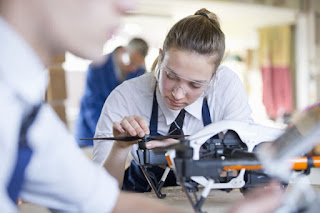
    Students working on a drone

    To understand how these labs changed perspectives, we conducted pre- and post-task surveys, analysing 33 matched responses from the 2023-24 and 2024-25 cohorts. The results revealed the following in student literacy:

    ●      Initially, students were fairly confident that GenAI could handle complex tasks. After the labs, this confidence actually dropped (from an average of 3.8 to 3.5 on a 5-point scale), suggesting that students gained a first-hand understanding of the inherent “hallucinations” and limitations.

    ●      Student confidence in their ability to identify AI-generated content (based on cues such as unnatural or “over-polished” text) rose slightly, from an average of 3.2 to 3.5. Overall, as indicated by their responses to our survey questions, most participants had some experience and a good understanding of cues that can reveal GenAI output before our teaching interventions. However, among participants with no prior experience, greater confidence in recognising AI-generated material was observed.

    ●      Interestingly, despite becoming more aware of the risks, students’ willingness to use GenAI in their studies increased (from 3.7 to 4.3). In addition, in their comments, students emphasised that, because GenAI tools and technologies are here to stay, the priority must be acceptance and education, so people are aware of how to use them effectively to maximise utility while minimising risk.

    ●      While the media often portrays AI as a threat to jobs, our students largely viewed it as a transformation. Many saw the obsolescence of certain tasks not as a negative, but as an opportunity for new roles and increased productivity. Interestingly, students expressed similar feelings of excitement and acceptance for GenAI use in both Higher Education and the workplace.

    Computer image of a face with letters coming out of it
    Conclusion

    Our findings suggest that early, structured engagement with GenAI, tied to subject-specific material, can foster more balanced and informed perspectives among students. Students with more awareness of risks and limitations seem to be more optimistic of the impact and potential of GenAI. However, we are mindful of the modest scope of our current research. Given the relatively small sample size and the specific context of our introductory module, these results serve as preliminary insights rather than definitive conclusions. We have identified areas for improvement, particularly in deepening students’ awareness of ethical and societal risks while reducing the likelihood that students feel overly confident about their ability to identify and manage AI-generated content without necessarily being aware of the full range of risks.

    Varvara Papazoglou is a Teaching Associate in the School of Computer Science, University of Sheffield. Her research interests include Artificial Intelligence, Music Information Retrieval, Computational Linguistics and Natural Language Processing, as well as Educational Research in Computer Science.

    When citing this work, please use the following citation:
    Papazoglou, V. (2026). “Attitudes Towards Generative AI: A Study with First-Year Computer Science Students” Centre for Engineering Education Blog, The University of Sheffield, Sheffield, UK. June 2026.
    https://ceesheffield.co.uk/2026/06/09/attitudes-towards-generative-ai-a-study-with-first-year-computer-science-students/
  • Becoming Comfortable with Black Box Engineering

    In this article, Professor Andrew Garrard from the University of Sheffield and Dr Parakram Pyakurel from New Model Institute for Technology and Engineering discuss whether engineering education’s traditional resistance to “black box” thinking remains fit for purpose. As simulation software, Industry 4.0 methods, and generative AI make it harder for engineers to understand the tools they use, is it time to take a pragmatic approach in education and consider black box engineering not as a threat to be resisted, but as an inevitability to be acknowledged?

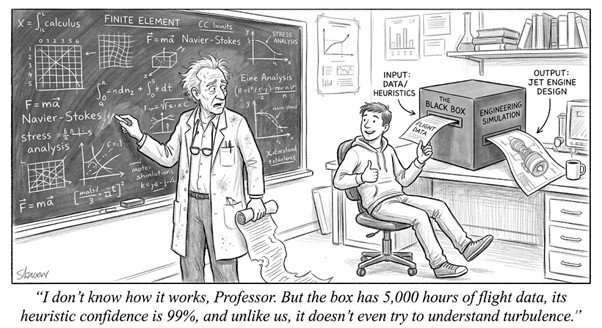
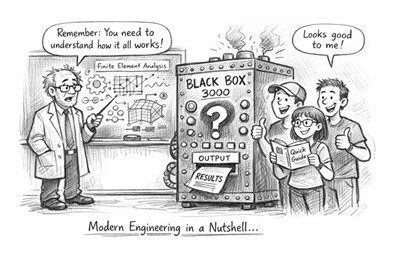
    cartoon of modern engineering in a nutshell

    Cartoon images generated by AI using the prompt “Please can you read this article and come up with a simple pencil drawing cartoon that makes light of the general themes of the piece?”. This image was created using Open AI’s ChatGPT 5.4.

    There is a widely held belief amongst engineering educators that students should be discouraged from relying on a “black box” approach to engineering; that is, producing results using methods and tools with little or no understanding of how they work. Moreover, it can be considered dangerous to certify a graduate as competent if they accept, on faith, the validity of results generated by means they do not understand.

    To what extent, however, is this view an anachronism, tightly clung to by academia but no longer reflective of real-world engineering practice?

    Cartoon images generated by AI using the prompt “Please can you read this article and come up with a simple pencil drawing cartoon that makes light of the general themes of the piece?”. This image was created using Anthropic’s Opus 4.6.

    Consider, for example, predicting how a system will behave through engineering simulation, such as by using the finite element method. In previous generations, it was conceivable that engineers could build, from the ground up, the software required to perform finite element calculations. This was possible because the limits of computational power meant that only relatively simple systems could be analysed using comparatively straightforward numerical techniques.

    Fast forward to today, and modern engineering simulation software can consist of hundreds of gigabytes of code and mind-bogglingly complex algorithms designed to optimise every stage of the process. Take the generation of computational meshes. In the past, engineers constructed meshes manually, deciding the position of nodes and connecting them together with lines. Today, powerful automated meshing algorithms generate highly complex meshes as part of a largely turnkey process.

    It is unrealistic to expect engineering students, who are learning multiple topics across a wide range of domains, to understand the detailed inner workings of every piece of software they use. As the ability to understand precisely what engineering simulation software is doing has diminished, it has been replaced by an increased emphasis on heuristics: I chose this turbulence model because experience suggests it performs well for this type of fluid flow.

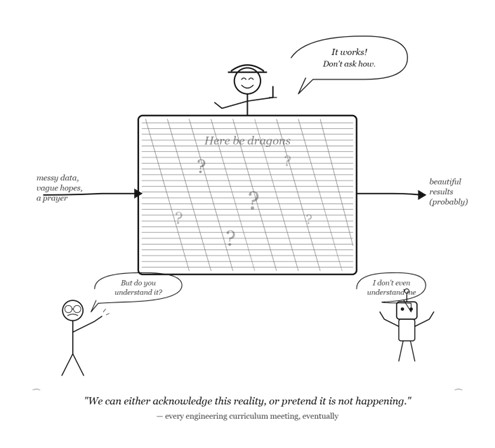
    Cartoon depicting black box engineering

    Cartoon images generated by AI using the prompt “Please can you read this article and come up with a simple pencil drawing cartoon that makes light of the general themes of the piece?”. This image was created using Google’s Gemini 3.1

    The same “black box” approach underpins many aspects of Industry 4.0, and more recently Industry 5.0. Rather than fully understanding the physical mechanisms governing the dynamics of engineering systems, sufficiently large datasets can be used to predict outcomes accurately through sophisticated statistical methods.

    The world is already full of black-box engineering, and this trend is only likely to accelerate with the rapid advancement of artificial intelligence. While it may be extremely challenging to fully understand all the methods used in modern, complex engineering software, the algorithms involved are at least deterministic. By contrast, the stochastic outputs of Generative AI, like large language models, means that determining how they will respond to any given input is not something anyone can reliably predict, even those who have built the models. As AI becomes increasingly embedded within software products, additional opaque layers will accumulate, making it ever more difficult to truly understand what the computer is doing.

    Whether the adoption of a “black box” approach to engineering is desirable remains open to debate. What seems less debatable, however, is its inevitability in the modern world. We can either acknowledge this reality, or pretend it is not happening.

    Once we admit this – what are the implications?

    The increasing complexity of computational methods, together with the advent of AI systems whose behaviour can be difficult to fully understand, may appear to be a distinctly modern problem. However, making predictions about how systems will behave with limited understanding of the underlying governing principles has long been the standard approach of empiricists.

    Often attributed to Heisenberg is the quote:

    “When I meet God, I am going to ask him two questions: Why relativity? And why turbulence? I really believe he will have an answer for the first.”

    As a species, we remain unable to analytically calculate turbulent flow. Yet engineers are able to model aeroplanes, pipelines, and wind turbines with impressively high precision. While imparting conceptual understanding of fundamental engineering principles is important, we may be overlooking opportunities to train students in data analysis, interpretation, and subsequent processing.

    As educators, our task is to equip students with the understanding and tools necessary to have a positive impact on the world. In already crowded engineering curricula, content must compete for inclusion among the many topics considered essential for an undergraduate programme. If complexity, big data, and stochastic computation are becoming commonplace, is there a need to shift some emphasis away from traditional physical sciences toward statistics, empiricism, and validation?

    When citing this work, please use the following citation:
    Garrard, A & Pyakurel, P. (2026). “Becoming comfortable with black box engineering”. Centre for Engineering Education Blog, The University of Sheffield, Sheffield, UK. March 2026. https://ceesheffield.co.uk/2026/10/27/blackboxengineering/

  • Adding Depth to Engineering Education

    Andrew Garrard from Multidisciplinary Engineering Education explores the role of 3D visualisation in engineering education and asks when it offers a genuine advantage over traditional 2D diagrams. Drawing on examples from practical teaching, including virtual lab tours, wind turbines and fluid mechanics, Andrew considers how 3D technologies can help students understand scale, spatial relationships and physical phenomena, while questioning whether their use always adds educational value.

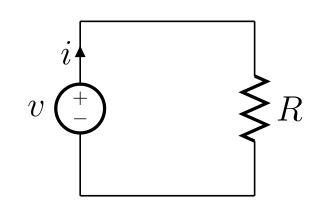
    Teaching engineering often involves using pictures. These pictures could depict the mechanics of some physical phenomena with a sketch, describe the relationship between different parameters with a graph or illustrate the interactions between components of a complex system with a diagram. If you imagine how you would explain any of the classic concepts of engineering science, things like bending moments in a beam, the development of a fluid boundary layer or the voltage and current in an electrical circuit, you will most likely include sketching schematic pictures to represent these systems as part of the process.

    Diagram

    Two dimensional representations are ubiquitous in the communications between engineers. Yet the world in which engineers apply their craft is, more often than not, three dimensional. So why is it that 2D drawings are so much more widely used to convey engineering concepts than 3D ones?

    For a long time the tools available to the engineering educator, such as notebooks, printouts, drawing boards and whiteboards, have been limited to flat surfaces. Common devices used for digital methods of communication, such as monitors, mobile phones and projectors are also mostly flat surfaces. But that isn’t necessarily going to remain the case and there are indications that 3D could become the new standard in how ideas are communicated.  Engineering educators need to pay attention to this.

    Firstly, although most digital devices have a flat surface to display their content, they have the advantage of being able to represent 3D objects by dynamically orienting the projection of the 3D object onto the 2D screen.  It is only recently that computing hardware has become powerful enough and software has been efficient enough to make the creation and manipulation of 3D content widely accessible. TinkerCAD offers the creation of 3D objects with nothing more than access to a web browser and passing 3D content between different systems is now almost a turnkey process.

    Secondly, students are much more likely to consume their content through a digital device rather than anything paper based, giving wider access to the potential to display 3D objects. This has been a clear trend for a number of years now, but the Covid-19 pandemic has cemented the superiority of the digital display of teaching material compared to the printed page.

    Finally, the potential future utilisation of virtual and augmented reality for all manner of common tasks cannot be ignored. While in its infancy, especially for teaching, the plummeting cost of VR hardware coupled with the noticeable investment being made by the large tech giants is an indication that this technology could become a mainstream component of how people interact.

    The limitations of traditional tools to articulate visual concepts have influenced our methods for communicating, such that the use of 2D visualisation is completely ingrained in our professional lives. I was taught engineering using 2D, so my mind thinks about explaining things using 2D and so the cycle continues. But as we are now all acutely aware, disruptive technologies can change traditional industries rapidly, and those that don’t pay attention get left behind.

    As with implementing any new technology, there is a cost in developing the skills required utilise the tools. To justify that investment of resources, there has to be a clear benefit. In many cases, the presentation of information in 2D will be preferable to 3D visualisation, as 2D schematics can be used to make complex systems straightforward to understand without the burden of having to manipulate the image to look around it. There are plenty of examples of the arguably unnecessary use of 3D to convey information where 2D would have worked equally well.

    In the Fluids Engineering lab, we were very excited to create and share with students, in advance of their experiments, a digital 3D version of our teaching wind tunnels. This allowed them to rotate around and zoom in and out of the equipment. The idea was to provide an introduction to the apparatus so students could prepare for the lab class. The tool is very impressive. However, the ability to rotate around the equipment and zoom into and out of the 3D object isn’t enormously helpful, as students using the real equipment will typically stand in front of the fixed equipment and do not experience the other viewpoints.  Manipulating the 3D object on the screen is quite fun, and there is an advantage in making an activity more engaging even if the extent of the communication of content isn’t enhanced. But if that is the justification, we should be conscious of this rather than kidding ourselves that we are adding any substantial value to the learning.

    As I am particularly interested in practical engineering education, I’m aware of the increased use of 3D photography and videos to provide virtual lab tours. Just type “360 lab tour” into google and you will find a plethora of examples.

    Wind Tunnel

    But is there any educational value in providing students a tour of the lab in advance of their arrival? There is definitely a marketing opportunity to show off impressive facilities and the possibility of students being less anxious about entering an unfamiliar environment. But I question if there is much learning from knowing the relative positions of the furniture or pieces of equipment in 3D that couldn’t be achieved through simpler means, like a map. Or signs. When students come into my Fluids Engineering lab, they can usually find the piece of equipment they are looking for after a quick scan around the room, because they are aware of what it looks like from a 2D photograph they have been provided with in advance.

    I’m constantly on the lookout for examples of where using 3D has a distinct advantage over other approaches. So far I have two, which I will offer here, but I’m keen to hear if people have others.

    To convey a sense of scale

    Engineers can work on some pretty big stuff. I can remember being taken to Drax Power Station as part of my undergraduate studies and being awed by the size of the various fans and pipes and other massive engineering things. When I led the programme for Energy Engineering I would always take my students to a wind farm. While you can explain that large turbines have 100 meter blades spinning at 150 miles an hour, to really sense what it feels like you need to stand underneath one. If you have never done it, I’d highly recommend it.

    Andrew Garrard in front of two wind turbines

    Obtaining a similar experience of scale and awe can be achieved using VR headsets. The sensation of being physically present isn’t quite the same, but the accessibility is unrivalled.

    Taking large groups of students on field trips is expensive and an organisational nightmare. Even relatively local sites will be a challenge to find the time to accommodate. But with a £300 headset students could travel to a range of different engineering facilities across the planet and once the content is created, the scalability is virtually unlimited.

    When 2D schematics do not represent 3D objects

    One of the more enthusiastically received experiments we do in the Fluids Engineering lab is the generation of smoke rigs. We can make small ones with custom built smoke ring generators, or giant ones with a plastic dustbin into which I cut hole in the bottom.  There is something mesmerising about watching the smoke gently precess down the length of the lab, holding together with stability afforded by the vortex.

    I ask students if they had ever seen anything like it before during their studies of fluid mechanics and I am surprised with how frequently the answer is that they have not.

    Andrew Garrard creating a large smoke ring

    I am surprised because they definitely have, as similar structures appear as “recirculation zones” in the step where pipes expand from a smaller to larger diameter – a reasonably classic piece of fluid mechanics that all students do learn about. But after some further questioning, it occurred to me that the lack of recognition is caused by the overwhelmingly common presentation of this structure in 2D. It had compromised their understanding of the actual physical manifestation of the system.

    Flow diagram

    Shown above is a slice through a circular pipe. The recirculation zones are the ovals and this is pretty much universally how they are depicted in all explanatory teaching material. But it is just a slice to allow it to be shown in 2D. In the real, 3D pipe this 2D cross section is rotated around the axis and the recirculation zones take on the shape of a doughnut, which an Engineering would call a “torus” because we are cool, and is almost identical to the structure seen in a smoke ring.

    I created the 2D water flowing form a smaller to larger diameter pipe schematic shown above in 2010 using open source vector graphics tool Inkscape. I chose 2D because this is the way I had been taught about recirculation zones and because building 3D content was prohibitively out of my expertise. However, if I were to prepare this teaching material in 2022, I would consider doing it in 3D using easily accessible, simply to use and free tools. In about 60 seconds and with nothing more than a web browser, I can create a torus in TinkerCAD, download the .STL and upload it to Sketchfab to embed within a webpage.

    When citing this work, please use the following citation:
    Garrard, A (2022). “
    Adding depth to engineering education” Centre for Engineering Education Blog, The University of Sheffield, Sheffield, UK. February 2022. https://ceesheffield.co.uk/2026/10/29/adding-depth-to-engineering-education/