Tag: assessment

  • Engineering and Teaching Shorts: Keeping CPD Bite-Sized and Impactful

    Michael Trikić explores how Engineering and Teaching Shorts (EATS) provides informal, accessible professional development for academic and professional services staff at the University of Sheffield. Established to encourage the sharing of teaching ideas and practical experience, the programme covers topics ranging from inclusive teaching and student wellbeing to digital skills and generative AI. The blog looks at how EATS responds to staff interests, works with the Centre for Engineering Education (CEE), and supports small changes in teaching practice through discussion, collaboration and shared learning.

    In Higher Education time is always in short supply, so finding space for meaningful professional development can be a challenge. That’s where Engineering and Teaching Shorts (EATS) comes in: a bite-sized, informal Continuing Professional Development (CPD) series that makes space for reflection, inspiration, and conversation, all over a buffet lunch.

    Led by Michael Wright, Faculty Education Advisor for Engineering, EATS offers a practical and engaging route into continuous learning for both academic and professional services staff. “It’s very much not a one-size-fits-all message,” Michael explains. “You’re not being told to do X or Y.” Instead, sessions are built around shared stories and practical examples designed to spark new ideas in day-to-day teaching.

    What is EATS? A format that sticks

    EATS is a CPD initiative established in the early 2010s by Professor Stephen Beck, here at the University of Sheffield. It was created to encourage peer-led development through practical sessions that highlight different approaches to teaching and learning, and since inception over 200 have been held.
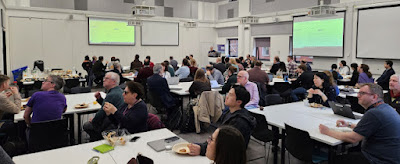
    University of Sheffield staff attending an EATS session

    Sessions are shaped around key themes in engineering education, from inclusive design and mental health support to generative AI and feedback strategies, and led by a mix of internal and external speakers.

    What sets EATS apart is its format. The programme is intentionally flexible, welcoming, and non-prescriptive, a structure that encourages ideas to circulate without pressure. “It’s informal,” Michael says. “You can engage as much as you like. You can sit at the front and ask questions… or just quietly absorb what’s going on.”

    How Topics Are Chosen: A Finger on the Pulse

    While some themes, such as mental health, international student support, or library updates, are recurring staples in EATS, the wider calendar is shaped by what’s current, timely, and useful to staff. Michael draws inspiration from university education conferences, listening for topics that spark discussion across faculties, and often invites speakers to adapt and re-share presentations for the engineering context.
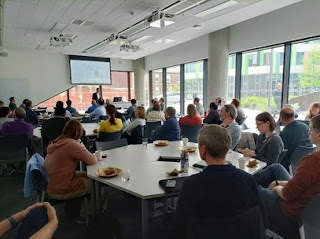
    University of Sheffield staff attending an EATS session

    This responsive model ensures that EATS stays relevant. Some sessions are prompted by sector-wide developments, like the introduction of Blackboard Ultra or the growing interest in generative AI.

    Others respond to quieter but meaningful shifts. For instance, after noticing staff concerns about students’ digital readiness, Michael invited colleagues from the 301 Academic Skills Centre to showcase training resources in tools like Excel, helping staff to meet students’ digital training needs.

    Ideas also emerge from informal channels. Conversations with colleagues and staff simply asking, “Could we have a session on this?”. That mix of structured insight and on-the-ground curiosity allows EATS to remain grounded in real teaching needs while reflecting broader trends in higher education. If you have any ideas for sessions, get in contact with Michael.

    Collaboration with CEE

    The collaboration between EATS and the Centre for Engineering Education (CEE) allows ideas from conferences and faculty projects to circulate more widely, with EATS sessions used both for sharing insights and testing new material.

    EATS sessions are also used to support both preparation for and reflection on conference participation. Staff who receive CEE funding to attend events are often invited to share their insights afterwards. For example, Professor Emma Norling shared her reflections from the Innovation and Technology in Computer Science Education (ITiCSE) conference with colleagues while Dr Michael Trikić used his inclusive engineering session to gather examples and refine his talk ahead of presenting at the SEFI conference.

    The initiative has also offered space for experimentation. A recent hybrid session on generative AI brought together staff from The University of Sheffield and University College Dublin, with both groups gathered in their respective locations and linked via video call—the first of its kind for EATS. “That was a really nice way to broaden the remit and deliver something engaging,” Michael said.

    The Impact: Small Bites, Big Shifts

    EATS sessions have prompted meaningful changes in teaching practice, from day-to-day adjustments to broader shifts in mindset. Staff shared their approaches to effective assessment in a well-attended EATS session, Assessment and Feedback at Scale. The following year, student feedback on that area improved in the NSS—a change Michael sees as “one of the contributing factors that maybe helped.”

    Sessions on cultural awareness and name pronunciation have also had a practical impact, especially in preparation for student-facing events like graduation. Staff have reported feeling more confident supporting international students and recognising the value of small details, such as learning how to pronounce Chinese names correctly.

    Others have taken away tools they can apply immediately. After attending a generative AI session, one staff member began using Google Gemini to assist with writing tasks, a tool Michael himself has adopted in his work. Sessions on student wellbeing have also helped staff feel better equipped to signpost mental health support and recognise when to seek help on a student’s behalf.

    Through these small but cumulative changes, EATS continues to shape a more responsive, inclusive, and thoughtful teaching environment. One practical session at a time.

    Citation:
    Trikic, M. (2025). “Engineering and Teaching Shorts: Keeping CPD Bite-Sized and Impactful” Centre for Engineering Education Blog, The University of Sheffield, Sheffield, UK. November 2025. https://ceesheffield.co.uk/2026/10/29/engineering-and-teaching-shorts-keeping-cpd-bite-sized-and-impactful/
  • Listening, Learning, Leading: Championing the Student Voice in Engineering

    Listening, Learning, Leading: Championing the Student Voice in Engineering

    As Faculty Director of Education for Engineering, Professor Matt Carré oversaw everything from curriculum design and student recruitment to, crucially, the student experience. Before he stepped down from the role, he took time to reflect on the many achievements and ideas he has championed.

    “Put simply, I’m the Faculty’s academic lead for everything related to education,” he explained, a role that spans collaboration with four schools, the Multidisciplinary Engineering Education team, and colleagues across the University of Sheffield.

    At the heart of his work is a simple but powerful belief: listening to students drives better education. Matt reflects on how the faculty has evolved its use of student voice, particularly through the National Student Survey and the University’s own ‘TellUS’ Survey, to shape meaningful change. From improving feedback to embedding new marking criteria, the focus is clear: supporting students to thrive in a fast-changing world.

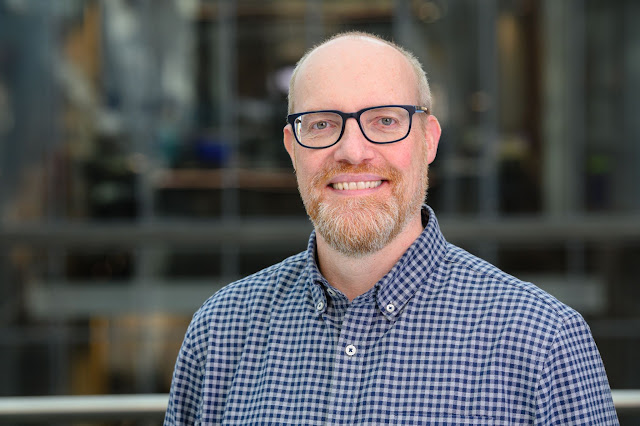
    A profile picture of Matt Carre

    The Power of Feedback: TellUS Survey

    Student feedback has long been a cornerstone of teaching development in Engineering, but the TellUs Survey has helped consolidate that input in more structured and scalable ways. Matt was part of the early working group that helped shape  the first University student  voice survey, which became known as TellUS. Before TellUS, Engineering had already developed its own faculty-wide survey.

    The aim of TellUS, he explains, has always been to strike a balance between consistency and relevance. “All our programmes across the University are different and our cohorts have different characteristics,” he says. “An Engineering student might approach a survey differently than someone in Arts and Humanities.” In Engineering, the decision was made early on to take a faculty approach using the same survey questions across all programmes to enable meaningful comparison and tracking.

    One of the biggest challenges has been student engagement. “If you’re only getting 10% of the students filling in the survey, chances are that’s not a representative group,” he notes. “You’re probably only hearing from either end of the bell curve, not the majority in the middle.” That’s led to faculty-wide efforts to shift the culture, particularly among first-year undergraduates. The introduction of Student Experience leads in each school has helped coordinate efforts, allowing the faculty to act cohesively while staying connected to local student communities.

    Still, feedback is only valuable if it’s useful. Part of that means helping students understand the purpose of these tools. “We need to communicate to students that doing a survey is part of being professional,” he says. “We don’t mind negative feedback. If it’s clear and specific, it’s helpful.”

    The TellUs Survey has also become more analytically robust over time. Comments are now processed using text analysis tools that surface key positive and negative themes–such as lab experience and assessments—that regularly appear across modules and programmes When the system works as intended, this feedback is passed to the relevant module leader, who is expected to share it with the teaching team and reflect on what’s working well and where improvements could be made.

    Closing the Loop

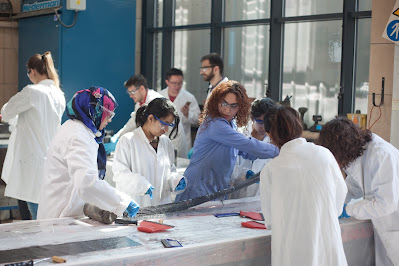
    Students in an aerospace lab

    While large-scale surveys like TellUS help surface common themes, meaningful change often starts with the small, specific shifts that happen at module level.

    In some cases, this has meant adding extra support where students needed it, whether through tailored resources or drop-in sessions. In the  module that Matt taught on this semester, he explains, “We put on extra office surgery sessions so that people who had questions about the assessment could come and see us, and this change came about because of what students told us via TellUS.”

    Assessment and feedback have consistently been a focal point for student comments. These concerns range from the clarity of marking criteria to how feedback is communicated, particularly in the transition from school to university. Many students arrive expecting highly prescriptive feedback, the kind that spells out exactly what they need to do to score higher. But university feedback is designed to develop independent learning, not to offer a formula for gaining extra marks. Bridging this gap means not only improving feedback quality but helping students understand how feedback works in a university context–and why.

    One concrete change already underway is a new faculty approach to marking criteria. From 2026/27, Engineering will implement a consistent framework across all schools and modules. The move reflects both student feedback and the need for clarity in assessment design.

    Ultimately, the goal is to create a more transparent and supportive learning environment. One where students can clearly see how learning outcomes, assessment descriptions, and marking criteria fit together. As Matt puts it, “If we can be more consistent in pulling together those three things and explain to students, this is the pedagogy of what we do… that can help them to understand.”

    Engineering Education, Reimagined

    Looking to the future, the faculty is focusing on how to deliver great education while evolving with the world around it. That includes better integration of digital and sustainability themes—not as add-ons, but as named pillars of the curriculum. These areas are essential, Matt says, because “engineers have a real part to play” in addressing challenges that matter across society.

    Tools like Blackboard Ultra are already helping with this shift. The Faculty is exploring how to “badge” modules with key Sheffield Graduate Attributes and UN Sustainable Development Goals, so students can more clearly see what skills and values they’re building, whether it’s teamwork, ethics, or sustainable design. Over time, this could develop into a full programme-level view that lets students and prospective applicants understand the shape of their academic journey from start to finish. “We’re not really there yet,” Matt notes, “but that is the aim.”

    When citing this work, please use the following citation:
    Carre, M (2025). “
    Listening, Learning, Leading: Championing the Student Voice in Engineering” Centre for Engineering Education Blog, The University of Sheffield, Sheffield, August 2025. https://ceesheffield.co.uk/2026/10/29/listening-learning-leading-championing-the-student-voice-in-engineering/