As engineers and scientists venturing into educational research, many face a familiar challenge: how do we apply our systematic, problem-solving mindset to the complex, human-centered world of education? If you’ve ever felt caught between the quantitative precision of engineering and the qualitative nuances of educational research, you’re not alone. Here, Edmund Padget shares his experience bring disciplinary thinking together.
I studied physics for my first degree, but when I started teaching, and reflecting on how to do it better, the engagement with educational research often made me feel alienated in my approach to problem-solving, rather than inspired to do educational research myself. It seemed to me (rightly or wrongly!) that most papers fell into one of these two categories:
- What looked like very complex philosophy/sociology papers – I did enjoy the complexity of them and the theoretical development, but it felt like solving a sudoku when the house was on fire.
- What looked like simple “what works” solutions – the simplicity of both the language and the ideas was very tempting, but I was apprehensive about the approaches that simultaneously ignored too many variables and were very context-dependent. Not to mention misuse of statistics!
I then started my doctoral studies, and the question of methodology became very real: I wanted to find out how the design of teaching and learning resources can support less experienced teachers in their planning and delivery, but I wanted to contribute more than a simple case study.
This is where I came across the design-based research (DBR), which I believe may encourage many more engineering educators into conducting educational research.
What is design-based research?
Design-Based Research is an iterative research methodology that combines the systematic approach engineers use with the contextual sensitivity that educational research demands. Think of it as the engineering design process applied to educational challenges, but with the rigor of academic research woven throughout.
At its core, DBR involves:
- Identifying a real educational problem (like we identify engineering challenges)
- Understanding the problem and its complexity
- Designing an intervention (our prototype solution)
- Testing it in authentic settings (real classrooms, not labs)
- Iterating based on evidence (continuous improvement)
- Generating both practical solutions and theoretical insights
DBR has an explicitly dual focus on both providing an applicable solution to a real problem, and advancing theoretical understanding. It also underlines the importance of an in-depth, multifaceted understanding of the initial problem, which I found particularly appealing, as Pólya’s “How to solve it” has underpinned most of my conceptual thinking, in physics and elsewhere.
What makes DBR particularly suited to engineering education?
It’s iterative and improvement-focused: just as we prototype, test, and refine our engineering designs, DBR embraces the iterative cycle. There’s no expectation of getting it “right” the first time – instead, each iteration builds on evidence from the previous cycle.
It solves real problems: unlike some educational research that can feel abstract, DBR always starts with a genuine problem that needs solving. Whether it’s improving student engagement in thermodynamics or developing better lab safety protocols, DBR keeps us grounded in practical impact.
It values multiple types of evidence: while we might be used to quantitative data, DBR recognises that educational contexts require multiple lenses. Student interviews, classroom observations, and learning analytics all contribute to understanding what works and why. Additionally, other teachers we work with can be co-designers in the solution design process, which in turn helps us build communities of research-informed teaching practice.
It produces actionable outcomes: DBR doesn’t just generate papers – it creates tested interventions that other educators can implement and adapt. It’s research with immediate practical value.
But isn’t it just problem solving?…
Since it is a relatively new methodology (well, 30+years old!….) that is still inventing itself, it has its critics who question whether DBR indeed generates valid knowledge. The discussion of such validity warrants a separate blog post, but papers using DBR have been published in key engineering education journals, and produced some very interesting findings: about broadening participation in pre-college engineering, about preparing students for addressing “wicked problems”, about online engineering education, about supporting undergraduate group projects, about developing digital resources for labs, about learning interdisciplinary thinking. This small sample of what’s “out there” should give you an idea for what’s possible.
And this systematic review of DBR research in engineering education offers even more examples!
How do I do it?
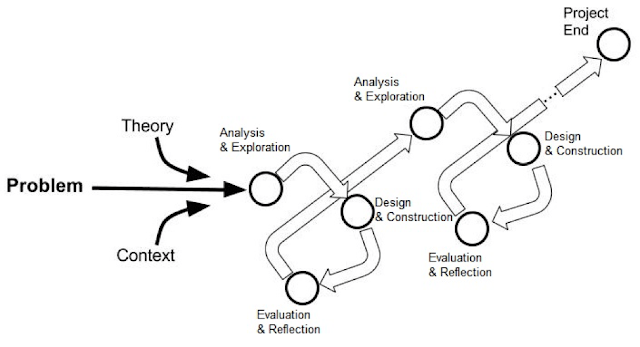
If you’re intrigued by DBR, here is a handy diagram to illustrate the DBR process:
 |
| Source: https://edtechbooks.org/studentguide/design-based_research (under a CC BY license) |
And here are some practical first steps:
- Start with a problem you genuinely care about – what educational challenge keeps you up at night?
- Think intervention, not just investigation – how might you design a solution worth testing?
- Plan for iteration – build time and resources for multiple cycles of testing and refinement.
- Embrace mixed methods – combine the quantitative skills you have with qualitative approaches that capture context.
- Document everything – your “failures” are as valuable as your successes for building understanding, and reporting negative findings is one of the ways in which DBR protects its academic validity.
Design-Based Research isn’t just another methodology – it’s a bridge between the systematic thinking that makes us good engineers and the contextual awareness that makes for good educational research. It honours our problem-solving instincts while pushing us to consider the human complexities that make education so fascinating and challenging.
As our field continues to evolve, we need research approaches that can keep pace with the complexity of modern engineering education. Design-Based Research offers us a way forward that’s both methodologically sound and practically meaningful – exactly what we need as we work to improve how we teach and learn engineering.
There are colleagues at CEE interested in this methodology, so do reach out to talk about collaboration!
Further readings:
Kelly, A.E. (2015). Design-based research in engineering education: Current state and next steps. In Cambridge Handbook of Engineering Education Research (pp. 497-518). Cambridge University Press. DOI: 10.1017/CBO9781139013451.032
Hjalmarson, M. A., & Parsons, A. W. (2020). Conjectures, cycles and contexts: A systematic review of design-based research in engineering education. Studies in Engineering Education, 1(2), 142-155. DOI: 10.21061/see.35
Minichiello, A., & Caldwell, L. (2020). A narrative review of design-based research in engineering education: Opportunities and challenges. Studies in Engineering Education, 1(2), 31-54. DOI: 10.21061/see.15
Kolmos, A. (2015). Design-based research: A strategy for change in engineering education. In International Perspectives on Engineering Education (pp. 373-392). Springer. DOI: 10.1007/978-3-319-16169-3_18
When citing this work, please use the following citation:
Padget, E. (2025). “Bridging two worlds: how design-based research can connect engineering problem-solving with educational research”. Centre for Engineering Education Blog, The University of Sheffield, Sheffield, UK. November 2025. https://ceesheffield.co.uk/2026/10/29/bridging-two-worlds-how-design-based-research-can-connect-engineering-problem-solving-with-educational-research/


