Tag: engineering education

  • Innovation in Engineering Education – The Diamond – Twelve Architects

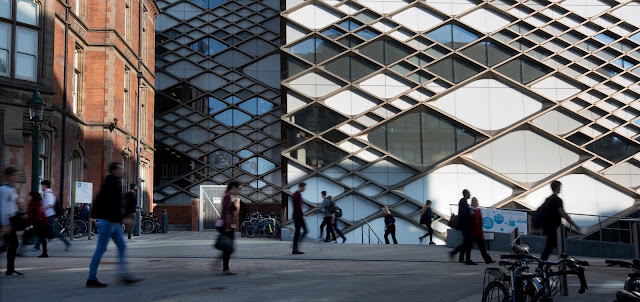
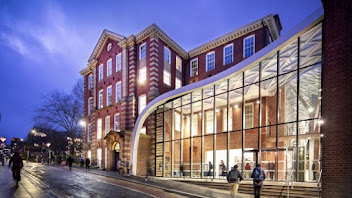
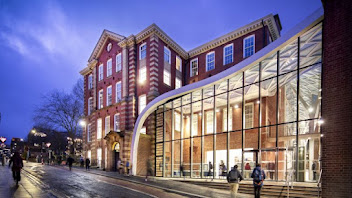
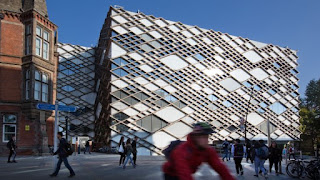
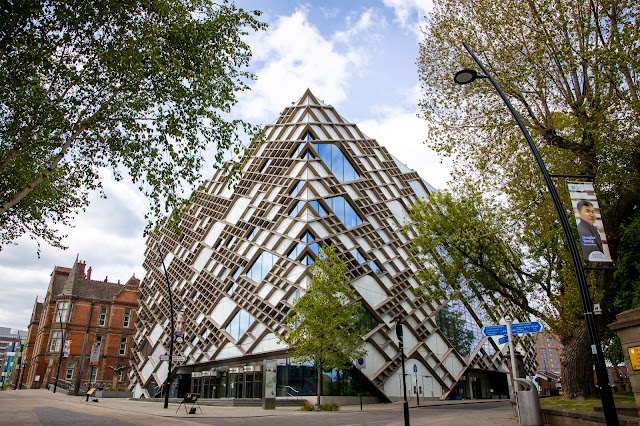
    Exterior of the diamond building

    The conception of the Diamond Building was a huge project here at Sheffield Engineering that aimed to make a world leading space for Engineering teaching. It is the home of  high quality teaching labs for all the engineering disciplines, as well as innovative teaching and study space. It is a wonderful space to be in and remains as popular as ever with students. The building led to the creation of a specialist multidisciplinary team to deliver and coordinate the teaching that takes place in it, and they continue to lead innovation in teaching and learning and are core contributors to the Centre for Engineering Education. This wouldn’t have been possible without the team who built the Diamond, Twelve Architects. They made the space both iconic and great for teaching, something that is often overlooked, but that has a huge impact on learning and learners. In this post Twelve Architects share their perspective of the project.
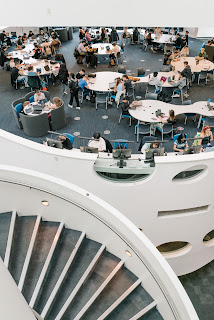
    study space in the diamond building

    September 2025 marked ten years since the opening of The Diamond at the University of Sheffield, a landmark project that continues to inspire over a decade on. As our first completed UK building, The Diamond was a defining moment for Twelve Architects, setting the tone for our approach to design, collaboration and innovation.

    Reflecting on this milestone, we asked members of the original design team, Matt Cartwright and Lorraine Stoutt Griffith, to share their experiences of working on the building that helped to shape our future as a practice.

    Designed to transform the way engineering was taught at the University, The Diamond brings together multiple disciplines under one roof, creating a flexible, future-focused environment that encourages interaction, learning and discovery. Ten years later, the building remains one of the UK’s most advanced teaching and research facilities, and one we’re immensely proud to have worked on.

    “The atrium remains one of the building’s most uplifting surprises,” recalls Lorraine. “It’s open, light and full of character, with a variety of places to spend time or work. We painted the steel structure orange to reveal how the building works. It’s a detail that makes it particularly special for the structural engineers who use it.”

    Behind the building’s confidence lies the complexity of its delivery. From the organically shaped windows to the curved pod walls, every detail required careful coordination. “It wasn’t without its challenges,” says Lorraine, “but the ambition and commitment across the team made it possible. Seeing it now, still thriving and crowded with students, makes it all worthwhile. It set a great standard for the student experience.”

    For Matt, the project carries a deep personal significance. “The vision was to create a landmark building that would attract students and staff, and support the University in becoming one of the leading engineering faculties in the UK and internationally,” he reflects. “The project was founded on trust, hard work and a collective desire to succeed. When challenges arose, we found solutions together, a rarity that shaped my belief in the power of collaboration.”

    Years later, The Diamond remains one of the UK’s most advanced and well-used engineering facilities, a space that is both functional and inspiring. Matt adds. “My parents met as students at the University of Sheffield. To have designed a building that continues to inspire future generations is priceless.”
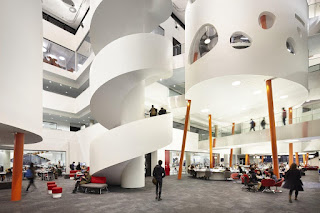
    spiral staircase in the diamond building

    Looking back, both Lorraine and Matt agree that The Diamond exemplifies the values that continue to guide Twelve’s work today: trust, ambition, quality and collective strength.

    “Be ambitious,” says Lorraine. “Bring the team with you, client, users, engineers, contractors, and maintain the quality of materials. It was a struggle to keep the cladding anodised, but seeing it now, it was absolutely the right decision.”

    “Trust, ambition and a clear vision,” echoes Matt, “are the lessons that we have carried through to every project since.”

    The Diamond continues to stand as a testament to design excellence, innovation and collaboration, and as a project that will always hold a special place in our hearts.

    When citing this work, please use the following citation:

    Hearne, B. (2025). “Ten Years of The Diamond – Twelve Architects”. Centre for Engineering Education Blog, The University of Sheffield, Sheffield, UK. January 2026. https://ceesheffield.co.uk/2026/10/27/innovationinengineeringeducation/
  • Celebrating over a Decade of Impact at The Diamond

    In this reflective piece, Sophie Barwick takes us through the special 10-year celebration of the Diamond building —now firmly established as the heart of engineering education at the University of Sheffield. From cutting-edge labs and inspiring staff, to the student-driven innovation of the iForge, Sophie shares how the Diamond has shaped her journey as both a student and GTA. Her insight captures the building’s enduring purpose: a space built for students, enriched by community, collaboration, and hands-on learning.

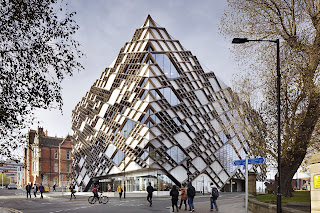
    Exterior of the diamond building

    Back in October 2025, the Diamond opened its doors to staff, students, alumni and visitors to celebrate 10 years of the Diamond building. Over this time the Diamond building has become a fundamental place for the education of thousands of engineering students at the University of Sheffield. The range of state of the facilities, enthusiastic staff and open study spaces make it a great place to learn and develop skills.

    The Diamond building offers a range of laboratories and lecture theatres to teach students engineering concepts from across all disciplines under one roof, marking it as the flagship teaching facility for the faculty. It therefore also enables students to have a base to explore new concepts and work together, particular crucial for those new to university and Sheffield.

    In addition to timetabled teaching, key part of the student experience in the diamond is the iForge – the UK’s first student-led makerspace. This facility allows both engineering and students from across the university to make their ideas reality while learning practical skills and, for those selected as iForge representatives, an opportunity to develop their teaching and leadership skills as well.

    Staff from a range of academic and industrial backgrounds form a team of teaching and support staff within the department of Multidisciplinary Engineering Education which is supportive, encouraging and enthusiastic about engineering education. The staff, primarily based in laboratories, teach students from a range of engineering disciplines and levels of study with the support and guidance relevant for their background. They also work throughout the year adapting lab activities to ensure they align with module content and current technologies.

    The Faculty of Engineering are able to offer and teach the activities to so many students in the diamond thanks to the assistance of graduate teaching assistants (GTAs). Often graduates from undergraduate courses at the University of Sheffield themselves, GTAs are current PhD students with expertise to help and guide students in each of the laboratories, increasing the staff to student ratio, and therefore better supporting the students.

    I was honoured to be invited as a guest on the “Student Experience” panel for the Decade of the Diamond celebration event. The Diamond building, and the facilities within it, have been fundamental to my development during my time at the University of Sheffield and it was great to be able to offer insight into my experience in as both a student and GTA in the Faculty of Engineering, University of Sheffield.

    It’s fantastic to see the student voice continue to be so actively involved in the continued evolution of the Diamond. After all, as Professor Stephen Beck said “the Diamond is and always was a building designed for the students”.

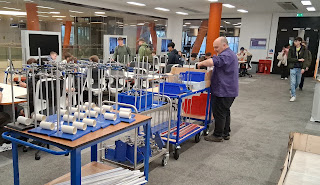
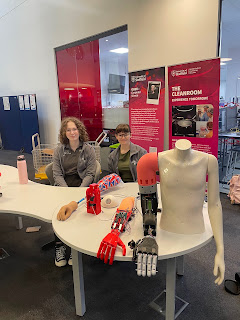
    Robotic arm on an exhibition stand

    In addition to the student voice session, the celebration event heard from many speakers key to the development of the Diamond building and the teaching within it, including the original architects from Twelve Architects,

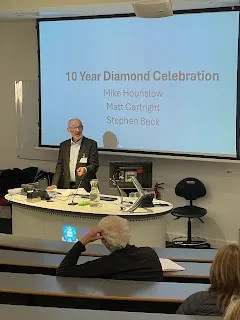
    Mike Hounslow delivering an opening address

    Professor Stephen Beck, the founding Head of Multidisciplinary Engineering Education, and Professor Emeritus Mike Hounslow, Pro Vice-Chancellor for Engineering during the construction. They reflected on the development of the Diamond from its original conception to how to it is still developing today.

    Sir John Lazar CBE FREng, president of the Royal Academy of Engineering, and representatives from across industry offered insight into how the Diamond building develops well-rounded engineering graduates, equipped with the skills they need for their future careers.

    Sir John Lazar CBE FREng, president of the Royal Academy of Engineering, and representatives from across industry offered insight into how the Diamond building develops well-rounded engineering graduates, equipped with the skills they need for their future careers.

    Throughout the day, in the Moonscape study area, there was stalls displaying the fantastic work of both the diamond laboratories and each of the schools in the faculty of engineering. There were also talks from many of the schools reflecting on the opportunities they offer students, with particular focus on inclusivity and accessible research and learning tools.

    The day also allowed for many opportunities to network with members of current and previous staff who have helped shape MEE, as well as those crucial in the realisation of the Diamond building itself.

    Many thanks to Harry Day, Emma Kenny-Levick, Andrew Garrard, and all involved in organising the event – I look forward to the next one!

    When citing this work, please use the following citation:

    Barwick, S. (2025). “Celebrating a Decade of Impact at The Diamond”. Centre for Engineering Education Blog, The University of Sheffield, Sheffield, UK. January 2026. https://ceesheffield.co.uk/2026/10/27/celebratingimpact/

  • Scaling Up Practical Engineering Labs for Teaching Spaces

    Thermodynamic lab in the diamond building

    Efficiency in engineering education is important for managing large cohorts and can be successful as long as the key metric is quality. Dave Brown, Rob Woolley and Andrew Garrard demonstrated how to do it, by scaling up and delivering a fundamental thermodynamics practical class for a large, non-specialist teaching space, with larger cohorts and with fewer sessions. Here, they share the secret to reducing staff time, improving flexibility, and creating a lively learning environment, with good student experience at the core.

    At Sheffield, we use innovative approaches to deliver practical teaching, such as workshop and laboratory classes, at scale. We aim to provide as much hands-on learning as possible. There are, however, limits to what we can offer. These limits may arise from timetable constraints, staff availability, or the amount of laboratory space.

    One way to overcome constraints on laboratory space, make the best use of staff time, and simplify student timetables is to teach fewer lab sessions to larger cohorts in suitable teaching spaces. Laboratory rooms are often smaller and more specialised than general flat teaching spaces, so this opens up the question of whether certain laboratory activities can be scaled up by running them in large, non-specialist rooms. For an activity to be suitable for scale-up, the equipment needs to be:

    ●     inexpensive enough to provide multiple sets

    ●     portable enough to be packed and transported

    ●     simple enough for students to set up and take down themselves

    ●     unlikely to cause mess or damage to the teaching space

    Case Study:

    Wind tunnel

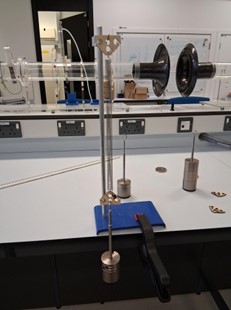
    In the thermodynamics laboratory, a 2nd-year exercise for Aerospace Engineering students involves investigating natural frequency using springs, masses, a ruler, and their phones as stopwatches. The session is open-ended: students decide the procedure within a clear aim, a loose brief, and examples of how to use the equipment.

    The equipment is normally prepared in advance so it is ready for students upon arrival. Previously, this activity ran seven times for 260 students in groups of 40, each session lasting 1.5 hours. This required 10.5 hours of contact time, plus seven rounds of setup and preparation.

    In the 25/26 academic year, this activity was scaled up and delivered in a flat teaching space with a capacity of 200. It ran twice, each time with 130 students working simultaneously (and the approach would permit up to 400 students without additional timetable demands).

    Observations

    To make the larger sessions manageable, students need to take greater responsibility for setting up and taking down the equipment, rather than relying on technical staff to do this in advance. While this requires clear instructions and uses some of the students’ learning time, it also increases students’ ownership of their experiment.

    There is also a noticeable increase in the energy of the environment. Smaller sessions can feel “flat”, but with over 100 students working on an activity in a single space, there is a strong “buzz” throughout the room.

    When running at this scale, careful consideration is needed when planning the degree of “scaffolding” provided to students. For efficiency, questions asked by students or common mistakes they can make can be anticipated and mitigated in the teaching material. For learning, it can be beneficial to engineer the session procedural speedbumps, to force students to consider what they are doing, why they are doing it and to initiate a conversation with lab staff. Addressing this tension is a delicate balancing act.

    The increased number of students in a single space will increase the possibility of students who have ASDs (diagnosed or not) becoming overwhelmed or having self-regulation issues that will impact their ability to engage with the lab activity or require them to leave. This would highlight the need to limit the number of students, so the extraneous cognitive load is kept to a manageable level.

    Finally, the model was shown to be more efficient in terms of GTA utilisation: not only were fewer GTA hours required, but it also allows for greater flexibility. With multiple small sessions, some groups will include students who need more support than others, leading to some sessions having sufficient GTA resources and others not enough. By combining students into a smaller number of sessions, these differences can be smoothed.

    When citing this work, please use the following citation:

    Garrard, A. Woolley, R. Brown, D. (2025). “Scaling Up Practical Engineering Labs for Teaching Spaces”. Centre for Engineering Education Blog, The University of Sheffield, Sheffield, UK. December 2025. https://ceesheffield.co.uk/2026/10/27/scalinguppracticalengineering/

  • Engineering and Teaching Shorts: Keeping CPD Bite-Sized and Impactful

    Michael Trikić explores how Engineering and Teaching Shorts (EATS) provides informal, accessible professional development for academic and professional services staff at the University of Sheffield. Established to encourage the sharing of teaching ideas and practical experience, the programme covers topics ranging from inclusive teaching and student wellbeing to digital skills and generative AI. The blog looks at how EATS responds to staff interests, works with the Centre for Engineering Education (CEE), and supports small changes in teaching practice through discussion, collaboration and shared learning.

    In Higher Education time is always in short supply, so finding space for meaningful professional development can be a challenge. That’s where Engineering and Teaching Shorts (EATS) comes in: a bite-sized, informal Continuing Professional Development (CPD) series that makes space for reflection, inspiration, and conversation, all over a buffet lunch.

    Led by Michael Wright, Faculty Education Advisor for Engineering, EATS offers a practical and engaging route into continuous learning for both academic and professional services staff. “It’s very much not a one-size-fits-all message,” Michael explains. “You’re not being told to do X or Y.” Instead, sessions are built around shared stories and practical examples designed to spark new ideas in day-to-day teaching.

    What is EATS? A format that sticks

    EATS is a CPD initiative established in the early 2010s by Professor Stephen Beck, here at the University of Sheffield. It was created to encourage peer-led development through practical sessions that highlight different approaches to teaching and learning, and since inception over 200 have been held.

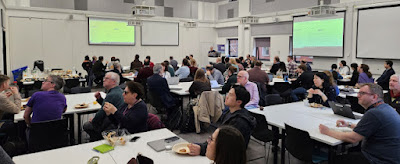
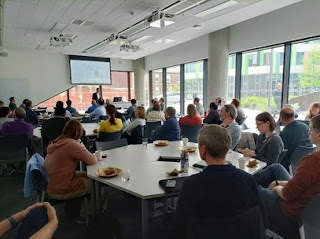
    University of Sheffield staff attending an EATS session

    Sessions are shaped around key themes in engineering education, from inclusive design and mental health support to generative AI and feedback strategies, and led by a mix of internal and external speakers.

    What sets EATS apart is its format. The programme is intentionally flexible, welcoming, and non-prescriptive, a structure that encourages ideas to circulate without pressure. “It’s informal,” Michael says. “You can engage as much as you like. You can sit at the front and ask questions… or just quietly absorb what’s going on.”

    How Topics Are Chosen: A Finger on the Pulse

    While some themes, such as mental health, international student support, or library updates, are recurring staples in EATS, the wider calendar is shaped by what’s current, timely, and useful to staff. Michael draws inspiration from university education conferences, listening for topics that spark discussion across faculties, and often invites speakers to adapt and re-share presentations for the engineering context.

    University of Sheffield staff attending an EATS session

    This responsive model ensures that EATS stays relevant. Some sessions are prompted by sector-wide developments, like the introduction of Blackboard Ultra or the growing interest in generative AI.

    Others respond to quieter but meaningful shifts. For instance, after noticing staff concerns about students’ digital readiness, Michael invited colleagues from the 301 Academic Skills Centre to showcase training resources in tools like Excel, helping staff to meet students’ digital training needs.

    Ideas also emerge from informal channels. Conversations with colleagues and staff simply asking, “Could we have a session on this?”. That mix of structured insight and on-the-ground curiosity allows EATS to remain grounded in real teaching needs while reflecting broader trends in higher education. If you have any ideas for sessions, get in contact with Michael.

    Collaboration with CEE

    The collaboration between EATS and the Centre for Engineering Education (CEE) allows ideas from conferences and faculty projects to circulate more widely, with EATS sessions used both for sharing insights and testing new material.

    EATS sessions are also used to support both preparation for and reflection on conference participation. Staff who receive CEE funding to attend events are often invited to share their insights afterwards. For example, Professor Emma Norling shared her reflections from the Innovation and Technology in Computer Science Education (ITiCSE) conference with colleagues while Dr Michael Trikić used his inclusive engineering session to gather examples and refine his talk ahead of presenting at the SEFI conference.

    The initiative has also offered space for experimentation. A recent hybrid session on generative AI brought together staff from The University of Sheffield and University College Dublin, with both groups gathered in their respective locations and linked via video call—the first of its kind for EATS. “That was a really nice way to broaden the remit and deliver something engaging,” Michael said.

    The Impact: Small Bites, Big Shifts

    EATS sessions have prompted meaningful changes in teaching practice, from day-to-day adjustments to broader shifts in mindset. Staff shared their approaches to effective assessment in a well-attended EATS session, Assessment and Feedback at Scale. The following year, student feedback on that area improved in the NSS—a change Michael sees as “one of the contributing factors that maybe helped.”

    Sessions on cultural awareness and name pronunciation have also had a practical impact, especially in preparation for student-facing events like graduation. Staff have reported feeling more confident supporting international students and recognising the value of small details, such as learning how to pronounce Chinese names correctly.

    Others have taken away tools they can apply immediately. After attending a generative AI session, one staff member began using Google Gemini to assist with writing tasks, a tool Michael himself has adopted in his work. Sessions on student wellbeing have also helped staff feel better equipped to signpost mental health support and recognise when to seek help on a student’s behalf.

    Through these small but cumulative changes, EATS continues to shape a more responsive, inclusive, and thoughtful teaching environment. One practical session at a time.

    Citation:
    Trikic, M. (2025). “Engineering and Teaching Shorts: Keeping CPD Bite-Sized and Impactful” Centre for Engineering Education Blog, The University of Sheffield, Sheffield, UK. November 2025. https://ceesheffield.co.uk/2026/10/29/engineering-and-teaching-shorts-keeping-cpd-bite-sized-and-impactful/

  • Bridging two worlds: how design-based research can connect engineering problem-solving with educational research

    Bridging two worlds: how design-based research can connect engineering problem-solving with educational research

    As engineers and scientists venturing into educational research, many face a familiar challenge: how do we apply our systematic, problem-solving mindset to the complex, human-centered world of education? If you’ve ever felt caught between the quantitative precision of engineering and the qualitative nuances of educational research, you’re not alone. Here, Edmund Padget shares his experience bring disciplinary thinking together.

    I studied physics for my first degree, but when I started teaching, and reflecting on how to do it better, the engagement  with educational research often made me feel alienated in my approach to problem-solving, rather than inspired to do educational research myself. It seemed to me (rightly or wrongly!) that most papers fell into one of these two categories:

    • What looked like very complex philosophy/sociology papers – I did enjoy the complexity of them and the theoretical development, but it felt like solving a sudoku when the house was on fire.
    • What looked like simple “what works” solutions – the simplicity of both the language and the ideas was very tempting, but I was apprehensive about the approaches that simultaneously  ignored too many variables and were very context-dependent. Not to mention misuse of statistics!

    I then started my doctoral studies, and the question of methodology became very real: I wanted to find out how the design of teaching and learning resources can support less experienced teachers in their planning and delivery, but I wanted to contribute more than a simple case study.

    This is where I came across the design-based research (DBR), which I believe may encourage many more engineering educators into conducting educational research.

    What is design-based research?

    Design-Based Research is an iterative research methodology that combines the systematic approach engineers use with the contextual sensitivity that educational research demands. Think of it as the engineering design process applied to educational challenges, but with the rigor of academic research woven throughout.

    At its core, DBR involves:

    • Identifying a real educational problem (like we identify engineering challenges)
    • Understanding the problem and its complexity
    • Designing an intervention (our prototype solution)
    • Testing it in authentic settings (real classrooms, not labs)
    • Iterating based on evidence (continuous improvement)
    • Generating both practical solutions and theoretical insights

    DBR has an explicitly dual focus on both providing an applicable solution to a real problem, and advancing theoretical understanding. It also underlines the importance of an in-depth, multifaceted understanding of the initial problem, which I found particularly appealing, as Pólya’s “How to solve it” has underpinned most of my conceptual thinking, in physics and elsewhere.

    What makes DBR particularly suited to engineering education?

    It’s iterative and improvement-focused: just as we prototype, test, and refine our engineering designs, DBR embraces the iterative cycle. There’s no expectation of getting it “right” the first time – instead, each iteration builds on evidence from the previous cycle.

    It solves real problems: unlike some educational research that can feel abstract, DBR always starts with a genuine problem that needs solving. Whether it’s improving student engagement in thermodynamics or developing better lab safety protocols, DBR keeps us grounded in practical impact.

    It values multiple types of evidence: while we might be used to quantitative data, DBR recognises that educational contexts require multiple lenses. Student interviews, classroom observations, and learning analytics all contribute to understanding what works and why. Additionally, other teachers we work with can be co-designers in the solution design process, which in turn helps us build communities of research-informed teaching practice.

    It produces actionable outcomes: DBR doesn’t just generate papers – it creates tested interventions that other educators can implement and adapt. It’s research with immediate practical value.

    But isn’t it just problem solving?…

    Since it is a relatively new methodology (well, 30+years old!….) that is still inventing itself, it has its critics who question whether DBR indeed generates valid knowledge. The discussion of such validity warrants a separate blog post, but papers using DBR have been published in key engineering education journals, and produced some very interesting findings: about broadening participation in pre-college engineering, about preparing students for addressing “wicked problems”, about online engineering education, about supporting undergraduate group projects, about  developing digital resources for labs, about learning interdisciplinary thinking. This small sample of what’s “out there”  should give you an idea for what’s possible.

    And this systematic review of DBR research in engineering education offers even more examples!

    How do I do it?

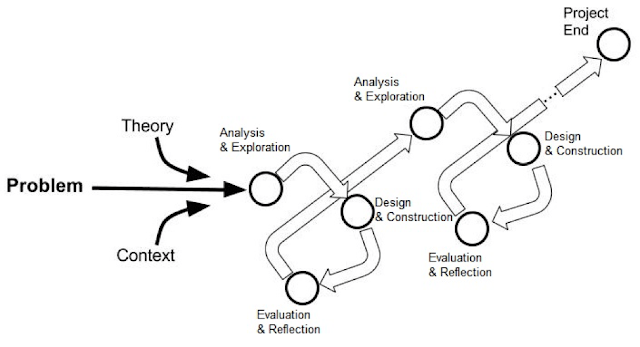
    If you’re intrigued by DBR, here is a handy diagram to illustrate the DBR process:

    A flow chart of the iterative Process of design-based research
    Source: https://edtechbooks.org/studentguide/design-based_research (under a CC BY license)

    And here are some practical first steps:

    • Start with a problem you genuinely care about –  what educational challenge keeps you up at night?
    • Think intervention, not just investigation – how might you design a solution worth testing?
    • Plan for iteration – build time and resources for multiple cycles of testing and refinement.
    • Embrace mixed methods – combine the quantitative skills you have with qualitative approaches that capture context.
    • Document everything – your “failures” are as valuable as your successes for building understanding, and reporting negative findings is one of the ways in which DBR protects its academic validity.

    Design-Based Research isn’t just another methodology – it’s a bridge between the systematic thinking that makes us good engineers and the contextual awareness that makes for good educational research. It honours our problem-solving instincts while pushing us to consider the human complexities that make education so fascinating and challenging.

    As our field continues to evolve, we need research approaches that can keep pace with the complexity of modern engineering education. Design-Based Research offers us a way forward that’s both methodologically sound and practically meaningful – exactly what we need as we work to improve how we teach and learn engineering.

    There are colleagues at CEE interested in this methodology, so do reach out to talk about collaboration!

    Further readings:

    Kelly, A.E. (2015). Design-based research in engineering education: Current state and next steps. In Cambridge Handbook of Engineering Education Research (pp. 497-518). Cambridge University Press. DOI: 10.1017/CBO9781139013451.032

    Hjalmarson, M. A., & Parsons, A. W. (2020). Conjectures, cycles and contexts: A systematic review of design-based research in engineering education. Studies in Engineering Education, 1(2), 142-155. DOI: 10.21061/see.35

    Minichiello, A., & Caldwell, L. (2020). A narrative review of design-based research in engineering education: Opportunities and challenges. Studies in Engineering Education, 1(2), 31-54. DOI: 10.21061/see.15

    Kolmos, A. (2015). Design-based research: A strategy for change in engineering education. In International Perspectives on Engineering Education (pp. 373-392). Springer. DOI: 10.1007/978-3-319-16169-3_18

    When citing this work, please use the following citation:

    Padget, E. (2025). “Bridging two worlds: how design-based research can connect engineering problem-solving with educational research”. Centre for Engineering Education Blog, The University of Sheffield, Sheffield, UK. November 2025. https://ceesheffield.co.uk/2026/10/29/bridging-two-worlds-how-design-based-research-can-connect-engineering-problem-solving-with-educational-research/

  • Taking the leap into Scholarly Activity

    Taking the leap into Scholarly Activity

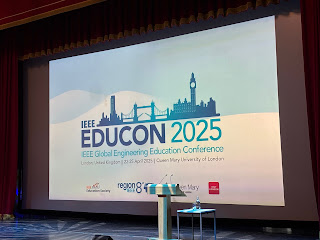
    Educon 2025 Presentation Slide

    What does it feel like to step into the world of academic conferences for the first time—not as a spectator, but as a speaker? For Laura Neasmith, it was a journey that began with hesitation and ended in confidence. At this year’s IEEE EDUCON, Laura shared research rooted in her MSc study on collaboration across staff roles in Multidisciplinary Engineering Education (MEE). In this blog, she reflects on the experience of presenting at an international conference, what she learned from others, and why professional services voices matter in engineering education.

    I confess that when I was initially encouraged to submit an abstract to the Institute of Electrical and Electronics Engineering (IEEE) conference, EDUCON, I was fairly confident that it would never be accepted and saw it more as part of a learning process of entering into scholarly activity. As someone not from a traditional academic background, imagine my surprise when the abstract was accepted, and a paper was then needed to accompany it. I had to accept that I was going to be attending my first ever academic conference as a contributor rather than an attendee.

    Exploring collaboration in MEE

    My submission was based on MSc research I had completed the year before, which explored interprofessional collaboration between staff groups within Multidisciplinary Engineering Education (MEE). I was particularly curious about how these collaborative efforts might influence the professional identity of the staff involved. At MEE, academic, technical, and administrative staff work together to co-deliver teaching in the labs, a model that is quite different from traditional teaching delivery and I wanted to understand how this unique setup might shape how staff perceive their roles.

    To explore this, I conducted interviews with members of the team and carried out a thematic analysis of their responses. My findings suggested that working across role boundaries in this interprofessional way had a significant positive impact on the student experience. The shared ownership of teaching delivery led to more cohesive and integrated lab pedagogy. I also found that recognising and valuing expertise across different job roles contributed to greater staff morale and job satisfaction.

    While the study did not provide conclusive evidence that this way of working directly affects professional identity positively or negatively it still offered useful insights.

    As a small scale study, it added to my understanding of collaboration across job groupings. Ideally, this kind of research could be replicated in a more traditional academic department, with the recognition that MEE’s interdisciplinary foundation may influence the outcomes.

    Presenting at EDUCON

    EDUCON is a global engineering education conference, and this one was hosted by Queen Mary University in London. This year, the conference organisers were particularly interested in submissions relating to multidisciplinary approaches in engineering education, and so the research I had undertaken seemed to complement this field.

    Attending such a prestigious conference, being in the company of hundreds of accomplished engineers, was daunting. Being a professional services staff member, these environments can feel overly ‘academic’ but everyone I interacted with during my time there was supportive, interested and happy to share their experiences. My own presentation went smoothly, and although I was nervous, I felt I was in good company with the other presenters. I was asked a great question from the audience about how the retention rate of the team could be attributed to the collaborative efforts within it which made me reflect on how unusual we are in MEE for supporting staff to develop outside of their job boundaries.

    Learning from Others

    I was also able to attend some really fantastic sessions; a highlight was from one of the keynote speakers, Professor Susan Lord from the University of San Diego. Her approach to applying ‘real world’ ethical challenges into her curriculum and how she engaged her students in thinking more contextually about how they will apply their engineering degree was particularly interesting.

    She described replacing outdated and irrelevant examples, like bridge building, with case studies more meaningful to her electrical engineering students.

    One example was the manufacture of tantalum in the Democratic Republic of the Congo, used in mobile phones. This introduced ethical questions around conflict mining, civil unrest, and the rise of illicit markets. It provided a much more relevant and thought provoking ethical scenario for future electrical engineers, while also preparing them for the real life dilemmas they might face in industry.

    This made me reflect more broadly on learning. When we feel that something applies to us, when we feel involved, I believe our learning is deeper and more lasting.  You can read

    a link to a chapter she collaborated on about ethical issues in engineering here: https://doi.org/10.4324/9781003464259-20.

    Reflections

    The overall experience of attending EDUCON was enjoyable for me; I really liked the opportunity to hear about initiatives happening across the sector. I feel very appreciative of the chance to be a small part of the overall event and would encourage others who perhaps feel overwhelmed at the idea of entering into ‘academic’ environments to give it a go Certainly the idea of presenting was much more terrifying when compared to the actuality of presenting. One thing that helped was reminding myself that my perspective, coming from professional services, added value precisely because it was different.

    When citing this work, please use the following citation:
    Neasmith, L (2025). “
    Taking the leap into Scholarly Activity” Centre for Engineering Education Blog, The University of Sheffield, Sheffield, UK. May 2025. https://ceesheffield.co.uk/2026/10/29/taking-the-leap-into-scholarly-activity/

  • A Cathedral to Engineering Education: The Diamond Building

    A Cathedral to Engineering Education: The Diamond Building

    Exterior of the diamond building

    Twelve Architects, who worked closely with engineers and University of Sheffield stakeholders to design and deliver The Diamond building, have taken the opportunity to reflect on what The Diamond has become and what it has meant to those who use it.

    More than a decade after its completion, The Diamond at the University of Sheffield continues to stand as a symbol of innovation in engineering education, and a career-defining project for many of those involved in its creation. As part of our ten year celebration, we asked members of the original client team to share their reflections on the building.
    For

    Stephen Beck, Professor of Mechanical Engineering at the University of Sheffield, The Diamond has had a profound and measurable impact on the Faculty and its students.

    “It has allowed us to double the size of the student cohort and helped position us as leaders in engineering education,” he reflects. “I show visitors around and say, ‘This is the best practical education environment in the world’ and I’ve never been contradicted.”

    From the outset, the design of The Diamond encouraged collaboration and cross-disciplinary learning, creating spaces that inspire both staff and students. Stephen Beck describes the experience of being part of the project as deeply rewarding: “It was great to be part of a team where each member used their skills to deliver a world-leading facility for engineering education. It’s certainly been a high point of my career. Truly career defining.”

    “It is a cathedral to engineering education”

    Professor Mike Hounslow, former Pro-Vice-Chancellor for Engineering at the University and often described as the “father of the project”, recalls how the building has shaped the University’s academic landscape: “We’ve seen growth in student numbers, an improvement in the student experience and a rise in educational aspiration,” he explains. “The building encouraged student-led activity and created a culture of openness and innovation. It’s a cathedral to engineering education.”
    Reflecting on the decade since its opening, he adds: “Its impact has only become more positive over time. It’s an iconic, open, and practical space that continues to define what engineering education can be.”

    “The building of choice”

    For Keith Lilley, former Director of Estates at the University, The Diamond has always been “the building of choice”. “The building was full from day one,” he recalls. “It immediately became the go-to place for student study, so popular that the growth plan was realised straight away.”

    Despite challenges during planning and construction, he describes the project as having a “lasting legacy”. “The Diamond was hard won, with planning hurdles and construction challenges, but it proved to be the most popular building with students. It undoubtedly contributed to the success of the Faculty of Engineering as a whole and remains a premium facility in UK higher education.”

    Today, The Diamond continues to feature prominently in the University’s promotional material, celebrated as a defining space for learning and collaboration. “It’s incredible,” he adds. “The building remains a lasting legacy, not only for the University but for everyone who worked on it.”

    A decade after its opening, The Diamond continues to embody the ambition and collaboration that brought it to life. Its success has paved the way for new approaches to education, inspiring similar developments across the UK and beyond.

    When citing this work, please use the following citation:

    Hearne, B. (2025). “A Cathedral to Engineering Education: The Diamond Building 10 Years”. Centre for Engineering Education Blog, The University of Sheffield, Sheffield, UK. December 2025. https://ceesheffield.co.uk/2025/02/16/a-cathedral-to-engineering-education-the-diamond-building/

  • Introducing Practice Exchange & Partnerships

    The Centre for Engineering Education (CEE) supports, promotes, and celebrates the outstanding teaching within the Faculty of Engineering. Laura Neasmith introduces an exciting new initiative designed to connect our experts with external organisations. Read on to discover how Practice Exchange and Partnerships are set to empower our community and further enhance our commitment to excellence in engineering education.

    At the Centre for Engineering Education (CEE) in the Faculty of Engineering, we’re all about supporting teaching staff and Graduate Teaching Assistants (GTAs) to deliver exceptional teaching and create a fantastic student experience. Our goal? To make Sheffield an acknowledged leader in engineering education.That’s why we’ve evolved our approach to external engagement into something more powerful: Practice Exchange & Partnerships. Through this work, CEE connects educators, researchers and external partners to share ideas, test new approaches and shape the future of engineering education together.

    Whether you’re looking for a keynote speaker, an expert advisor, or a partner for educational innovation, CEE can help you connect with the right people across the Faculty of Engineering.

    What is a Practice Exchange?

    Practice Exchange is at the heart of what we do. It creates space for educators to learn from one another — within Sheffield and beyond — by sharing real teaching challenges, emerging ideas and practical innovations.

    These exchanges can take many forms:
    from visiting speakers and informal discussion events, to joint workshops, international visits and longer-term collaborations that lead to new projects and research.

    The aim is simple but powerful: to bring people together around teaching practice, so that new ideas can be explored, refined and taken forward in a supportive, open environment.

    Practice Exchange in Action: Building connections

    Back in 2025, CEE launched a collaboration with Sheffield Hallam University to bring together engineering educators from across the city.

    Two informal Practice Exchange events created space for colleagues to share teaching ideas, explore common challenges and learn from one another. The first, hosted in The Diamond, featured short talks on topics including bioengineering labs, spreadsheet-based finite element analysis, inclusive teamwork and Multidisciplinary Engineering Education Project Weeks. These sparked lively conversations about how similar approaches could work in different contexts.

    A reciprocal event at Sheffield Hallam continued the dialogue, introducing ideas such as low-fidelity simulations for lab preparation and digitally enhanced learning activities.

    Participants valued the chance to meet peers working on similar problems and to build relationships beyond their own institutions — showing how powerful early-stage sharing can be in generating new collaborations and fresh approaches to teaching.

    CEE also hosts international Practice Exchange visits. Again in 2025, the Centre welcomed Dr Darson Li from the University of New South Wales for a two-day exchange focused on engineering education and curriculum innovation.

    During his visit, Dr Li met educators from across the Faculty and explored how teaching and learning happens in The Diamond — from design and make spaces to aerospace projects and engineering design teaching. These conversations allowed both sides to compare approaches and identify shared interests.

    He also delivered a well-attended EATS lunchtime seminar on using file metadata to help detect plagiarism, sparking new discussions and opening up future collaborative opportunities. Follow-up conversations are already under way, with plans for joint educational research and further exchanges.

    Our Specialist

    CEE works with a wide network of education-focused staff across the Faculty, including:

    • Principal Fellows of the HEA
    • National Teaching Fellows
    • Academic leads in engineering education
    • Specialists in curriculum design, assessment, inclusion and digital learning

    Together, this community brings deep expertise in how engineering is taught, learned and experienced by students

    Why This Matters?

    Engineering education is changing fast — with growing emphasis on hands-on learning, inclusive practice, digital innovation and strong links between universities and industry.

    Practice Exchange & Partnerships helps Sheffield stay at the forefront of those changes by creating meaningful connections that lead to better teaching, stronger curricula and richer student experiences.

    If you’re interested in collaborating, learning from our educators, or exploring what a partnership might look like, we’d love to hear from you.

    Contact us at: cee@sheffield.ac.uk

    When citing this work, please use the following citation:

    Neasmith, L. (2025). “Introducing Practice Exchange and Partership”. Centre for Engineering Education Blog, The University of Sheffield, Sheffield, UK. October 2025. https://ceesheffield.co.uk/2026/10/29/introducing-practice-exchange-partnerships/

  • The Centre for Engineering Education Outputs Page

    The Centre for Engineering Education Outputs Page

    The Centre for Engineering Education (CEE) is supports, promotes and celebrates the excellent teaching in the Faculty of Engineering. Here, Professor Stephen Beck and Emma Kenny-Levick share information about a new initiative.

    Back in December 2024, The Centre launched a new Outputs Page, designed to showcase the incredible Engineering Education that is happening across the Faculty of Engineering. The page brings together a wealth of education outputs that highlight the Centre’s commitment to advancing engineering education. From published papers and journal articles to conference presentations and workshops, the Outputs Page provides a comprehensive look at how CEE is sharing its expertise with the wider academic and professional community.

    Exterior of the Heartspace Building

    By celebrating and sharing these outputs, the Centre’s aim is to foster collaboration, spark new ideas and make resources available for others to access.

    The idea is for this new section to showcase ideas and academic staff. This Outputs Page is also another avenue to enhance the reputation of Sheffield’s Engineering Education and its educators.

    Why Explore the Outputs Page?

    Whether you’re looking to discover innovative teaching practices, explore impactful research, or gain inspiration for your own projects, the Outputs Page is the perfect starting point. Staff will be happy to discuss their work with you. This might be finding out what happened next, to how it might work in your context. You can also invite the authors to talk to staff in your own establishment.

    The page is divided into sections so you can easily find items. The sections are

    • Journal Articles and publications
    • Book
    • Hosted conferences
    • Invited talks and Keynotes
    • Workshops and Webinars
    • Blogs
    • Engineering and Teaching Shorts (Eats)
    • External / Other Engagement

    Using these, you can easily find our activities and outputs, but you can also get some ideas of education initiatives you might like to implement. Contact the Centre of Engineering Education, CEE@sheffield.ac.uk to find out more.

    Keeping the Outputs Current

    The page will be regularly updated to include the latest outputs, ensuring it remains a valuable resource for the Engineering Education Community . The Centre’s Networks and the Research Support Group will also capture outputs and also encourage staff to develop their careers using this resource.

    A Strategic View

    One of the Centre for Engineering Education aims is to raise the reputation in the Engineering Education firmament, they are working to showcase teaching ideas, outputs and staff to the sector.

    Exterior of the Diamond building

    The next initiative is to make it easy to find people who you can work with on projects or use to enhance your own teaching. This will be the ‘Practice Exchange and Partnerships’ section.

    Here we will make it easy to find Educators who are available to share their expertise with you. If you are looking for examiners, accreditors, speakers or someone to bounce ideas off, this will be the place to start your search.

    When citing this work, please use the following citation:
    Kenny-Levick, E.
    Beck,S. (2024). “The Centre for Engineering Education Outputs Page” Centre for Engineering Education Blog, The University of Sheffield, Sheffield, UK. December 2024. https://ceesheffield.co.uk/2024/12/13/the-centre-for-engineering-education-outputs-page/

  • “Tasty”-style Lab Videos: what, why and how to make fast-paced, engaging videos

    “Tasty”-style Lab Videos: what, why and how to make fast-paced, engaging videos

    Cathy Collett from the School of Chemicals, Materials and Biological Engineering at the University of Sheffield gives an overview of a novel style of lab video.

    What is a Tasty-style Lab Video?

    For the last couple of years, I have been experimenting with making lab videos in the style of recipe videos. The kind that auto-plays on your social media feed as you scroll down. You can watch an example for Apple Pie here.

    This video style has been referred to elsewhere as the “Tasty” style, and there are a few aspects that appeal to me:

    • you could get an overview of how to make a recipe in just one or two minutes
    • you can watch without requiring audio (e.g. on the train without having to get your headphones out, or turn your music off)
    • the high-speed presentation is informative and engaging
    • the overhead first-person perspective better represents what you would actually see if following the recipe

    I wondered if this could be an effective way of demonstrating experimental techniques to engineering students. There is plenty of research on the pros and cons of shorter videos, and the benefits of first-person perspective videos (“point-of-view”). I hadn’t considered omitting the narration before. From Mayers’ multimedia learning theory, I’d assumed narration would be beneficial, as the brain can process both visual and auditory stimuli in parallel. However, a meta-analysis by Adesope and Nesbit found that there was little benefit to spoken-written presentations compared to written-only presentations – a concept they termed “verbal redundancy”. I haven’t seen any research on the use of this video style to support laboratory teaching in Higher Education, so I decided to give it a go!

    Why make a Tasty-style Lab Video?

    So far I’ve piloted this video style with three different cohorts of engineering students:

    • Foundation Year Chemistry module (CPE007). After all, experimental procedures in chemistry can often feel like following a ‘recipe’ – add a few ml of this, a few grams of that, heat it up and see what happens. (Although we strongly advise against eating the product afterwards.) You can watch an example for Ion Exchange here.
    • Masters level Applied Energy Engineering (CPE6311). The Clean Energy experiment involves testing four different pieces of equipment: a solar panel, a wind turbine, a hydrogen electrolyser and a hydrogen fuel cell. The students on this course are primarily international students with English as an additional language, so I was interested to see if they found the videos useful. You can watch an example video for Electrolysis here.
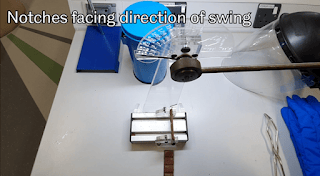
    • First year Danger Lab. This is an induction lab taken by all first year Engineering students at Sheffield. Students compare the energy needed to break a piece of chocolate at room temperature and liquid nitrogen temperature. We asked students for feedback via an anonymous survey. You can watch the 1-minute Danger Lab video here. A screenshot is shown below.
    Tasty style video screen shot

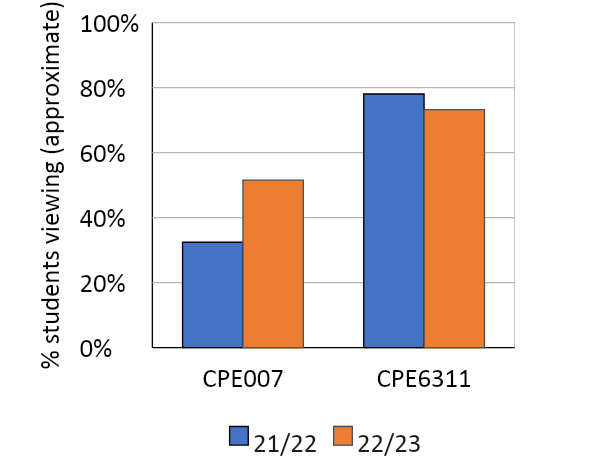
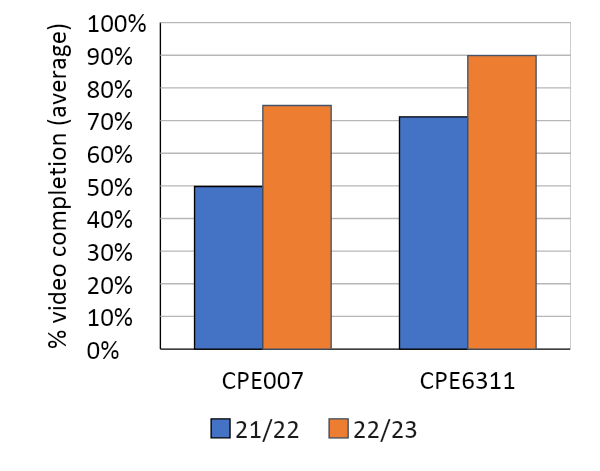
    Being an engineer, naturally I wanted to assess the effectiveness of the videos using numbers! For CPE007, after changing to a Tasty-style video, we found the percentage of the class viewing the video increased from 32% to 52%. For CPE6311 videos we found the percentage of the class viewing remained high, although it did drop slightly from 78% to 73%. In both cases, the percentage of students watching the videos to the end increased, indicating that students found the videos engaging.

    image of a graph 1
    image of a graph 2

    For Danger Lab, we found that more students watched the 1-minute video compared to a traditional 5-minute video (574 vs 510 unique viewers), and more watched it to the end (91% vs 65% completion), again indicating that students found the video engaging. The feedback from first year engineers was very positive. Comments included “I liked it a lot, very convenient”, “I liked the short time format because it made the video easily digestible” and “I liked the videos that accompanied each instruction.” No students commented that the video was too fast or difficult to follow, and no student requested narration to improve the video. The main area for improvement was requests for more detail (e.g. zooming in on the liquid nitrogen tank or showing how to set the initial impact energy).

    How to make a Tasty-style Lab Video?

    I started off using a digital camcorder and tripod to film these experiments, however the tripod was difficult to work around. I now use an overhead mobile phone clamp, available from the Creative Media Team, and an LED light stick to improve the lighting of the videos.

    Example of an overhead arm clamp for a mobile phone, used to achieve the first-person perspective for Tasty-style videos

    Whilst recording, I realised an additional advantage of this style of video: it didn’t matter what else was going on in the lab at the time! As I wasn’t using the audio, it didn’t matter what conversations, crashes or explosions were going on in the background.

    As long as I had a corner where I could get on with an experiment, I could keep the camera focused on the experiment and it wouldn’t be filming anyone else in the lab. This meant it was logistically much easier to get the videos filmed.

    The main barrier I anticipate staff will have to trying this video style is the time taken to learn how to do the editing. I used Adobe Premiere Pro for the first time in this project, learning from videos from Sheffield’s Creative Media team. It did take me a full working day (and a lot of banging my head against the desk) to get it installed and work out how to do the basic functions like zooming, speeding up and adding captions. However, now that I’ve got the hang of it, I find the editing reasonably straight forward. As it is all one camera angle with no narration, it takes me about 1-2 hours to produce a 1-minute video.

    What next?

    If you’d like to trial this video style in your own labs, whether at Sheffield or elsewhere, please do get in touch with me (Cathy Collett, c.h.collett@sheffield.ac.uk) – I’d love to know how it goes! You can also check out our Google Site where we’ll be adding resources, guidance and case studies.

    When citing this work, please use the following citation:
    Collett, C (2024). “
    “Tasty”-style Lab Videos: what, why and how to make fast-paced, engaging videos” Centre for Engineering Education Blog, The University of Sheffield, Sheffield, UK. June 2024. https://ceesheffield.co.uk/2026/10/29/tasty-style-lab-videos-what-why-and-how-to-make-fast-paced-engaging-videos/