Tag: engineering labs

  • Teaching with a Twist: Star Wars, Science, and Student Confidence

    Teaching with a Twist: Star Wars, Science, and Student Confidence

    In this blog, Marsya Ali profiles Dr Julian Dean, Senior Lecturer in Materials Science at the University of Sheffield and winner of the University’s Education Award for Teaching Practice in Engineering and Overall. The blog explores Julian’s approach to making engineering education engaging and accessible, from developing interactive virtual experiments through FlashyScience to using humour, creative examples and accessible language to help students understand complex concepts.

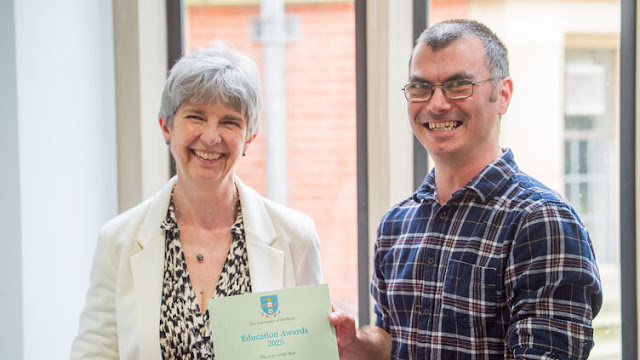
    When Dr Julian Dean was named winner of the University of Sheffield Education Award for Teaching Practice in Engineering and Overall, he described it as “really nice to be recognised.” But for Julian, a Senior Lecturer in Materials Science, the award wasn’t the goal. “I would have done [these things] without the award there,” he says. “It’s nice to know that it’s been seen as good practice.”

    Teaching Practice (Engineering) and Overall winner for teaching practice

    That practice includes everything from playing a guitar power chord to open lectures, to giving lectures with titles like The Phantom Error. But behind the humour is a clear pedagogical goal: to create experiences that engage students on their own terms, whether that’s through themed worksheets, accessible language, or interactive virtual labs.

    Julian’s standout contribution, FlashyScience, exemplifies this approach. Co-developed as a virtual lab platform that enables students to experiment at their own pace, Dr Joanna Bates described it as “revolutionising learning and solidifying understanding in engineering and science.” Combined with his outreach work, visual storytelling, and ever-evolving use of digital tools, it’s no surprise Julian’s approach resonates—not just with students, but with colleagues across the Faculty.

    FlashyScience: A lab beyond the classroom

    FlashyScience began as a school outreach project, driven by a simple question: how far could you stretch students beyond the curriculum? Co-founded with Professor Dan Allwood, the idea grew from a series of in-person STEM sessions into a spin-out company offering fully interactive virtual experiments.

    Screen shot of a virtual tensile tester experiment set up from the Flashy Science website
    The FlashyScience virtual ‘tensile test’ experiment

    At the heart of FlashyScience is accessibility. Giving learners the chance to experiment at their own pace, repeat processes without risk, and explore concepts far beyond GCSE level. From simulating tensile testing to observing radioactive decay across decades, students can interact with complex ideas in a safe, self-guided environment. It’s used by schools and universities alike, including in Sheffield’s undergraduate teaching.

    For some students, the platform has helped build confidence, especially those who might otherwise hesitate in physical lab spaces. “This has allowed a completely flat playing field,” Julian says. “Everyone can do it in their own time, at their own pace… and they get a bit more confidence about that.”

    Making Lectures Memorable

    Julian’s lectures are anything but ordinary. From The Phantom Error to festive worksheets on Santa stuck in a chimney, his sessions weave engineering concepts into familiar pop culture and playful scenarios. “It’s just really silly,” he says, “but the students seem to love it.”
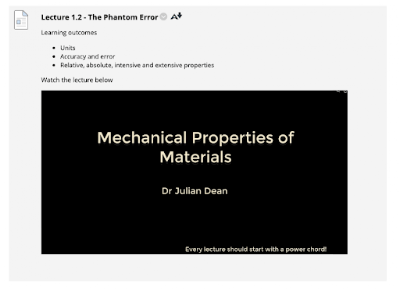
    presentation slide for mechanical properties of materials

    What started as a way to make sessions more engaging has become part of his teaching identity. During COVID, unsure how to begin recorded lectures, Julian decided to open each one with a guitar power chord—a choice that quickly became a student favourite.

    These elements aren’t just for show. They help students stay alert, connect with the content, and enjoy the learning process. “If you enjoy something, you’ll do it,” he explains—a principle that underpins his approach to making technical content memorable and accessible.

    Accessible Teaching: Simplified Language, Not Simplified Ideas

    Julian often uses simple analogies to make abstract concepts easier to grasp such as comparing atoms in a lattice to people holding hands: break the link, and the surrounding bonds might shift, redistribute, or even fall apart.

    This approach is especially useful for international students, who may be processing both scientific content and unfamiliar colloquialisms. By avoiding jargon, Julian ensures ideas remain accessible without being oversimplified, helping all students engage with confidence, regardless of background.

    Teaching That Thinks Like a Student

    Whether he’s building virtual labs or weaving pop culture into problem sets, Julian’s focus is always the same: thinking about how students learn best. “Not everyone learns in the same way,” he says. A reminder that accessibility and creativity aren’t add-ons, but core to effective teaching.

    That mindset is shaping what’s next. Starting this September and in partnership with the IOM3 and Discover Materials, first-year students in Materials Science will design their own outreach resources, from videos to podcasts, aimed at helping schoolteachers explain materials concepts. “They can pick five-year-olds if they really want a challenge,” Julian says. “Or 18-year-olds from college.”

    Students will choose everyday objects that interest them, from hockey sticks to climbing shoes, and link those to real-world materials science and school-level syllabuses. It’s part of a new collaboration with the Institute of Materials, Minerals & Mining (IOM3).

    It’s the same philosophy that runs through all of Julian’s work: teaching that meets students where they are, sparks curiosity, and gives them tools to go further.

    This is the first in a series of profiles of Engineering teaching staff at the University by Marsya Ali.

    When citing this work, please use the following citation:
    Ali, M (2025). “Teaching with a Twist: Star Wars, Science, and Student Confidence” Centre for Engineering Education Blog, The University of Sheffield, Sheffield, UK. July 2025.
    https://ceesheffield.co.uk/2026/10/29/teaching-with-a-twist-star-wars-science-and-student-confidence/
  • Laboratory Size and Student Expectations – publishing educational research and the scholarship process

    Laboratory Size and Student Expectations – publishing educational research and the scholarship process

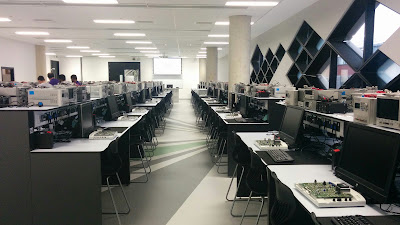
    Electronics and Computer Lab in the diamond building

    The size of a class has impact on learners, learning and the expectations of learners, and recent Centre for Engineering Education publications confirm this to be the case for Lab classes. Here Stephen Beck shares his insight into how to plan and run great lab classes on scale, but also the scholarly process in engineering education, and sometime the answers are at home.

    Many of the experiments that take place in engineering labs have an online alternative assessment which students can complete if they are unable to attend labs. Many courses have labs, but not marks associated with them, so incentives to attend can be low, even though labs form a valuable opportunity for learning and can be integral to the courses. There is great educational value for students who participate in the labs, so we asked the question : Why do students choose to attend labs or skip labs? By finding the answer we could work out how to make them more enticing.

    We used questionnaires to collect data because we have found it to be an effective approach in the past, and used it as an opportunity to ask staff what they thought labs were for.

    Reviewing the literature turned out to be more difficult than I’d assumed; I couldn’t find anything on students NOT attending labs. There were plenty of papers on labs themselves, and a number stating that lab attendance improved student performance [1]. Fortunately, my daughter (who is a social scientist) was at home at the time and when I lamented about not finding anything useful, she suggested that I search for why students DO attend laboratories. Still nothing…so after a further discussion, I looked for literature for why students attend lectures, and this revealed a collection of useful papers [2]. By learning from the educational research in social science, engineering educators have much to gain. In fact, educational research demands many development of new skills to be effective in this research field by most engineers. Engaging with social scientists is therefore vital! In the faculty of Engineering at Sheffield, a route to this expertise (and co-authorship) is via Sarah Plump in Elevate (the University’s learning and teaching educators) and Tim Herrick from the School of Education, particular in the design and analysis of qualitative and quantitative data.

    The literature showed that the main reasons why students don’t attend lectures are: because they are unwell (often hungover), do not think that it is a good use of their time (either they don’t need the learning or they can get it more effectively elsewhere) and that they have other, more pressing, assignments or work to do. Essentially, this is what we found for labs.

    Our research led to interesting insights into student and staff perception of what they thought labs were for. It is clear that staff and students agree on the top two reasons for attending (reinforcing lecture material and the practical experience) (Figure 1). Staff were also asked why they thought students attended labs. Here the top answers were, ‘To get a practical experience’, followed by ‘To get marks’ and ‘Part of any engineering course’ which contrasted with the students with regards to the latter two responses. This mismatch is interesting as staff may not be using reasons that resonate with students to encourage them to attend laboratory sessions. Again the literature shows that Staff encouragement is a key tool in encouraging attendance.

    Graph of student and staff perception of what labs are for

    Additional questions on lab group size and lab duration showed that students like short labs and small groups. At Sheffield, we have been optimising our labs for student learning and experience. Most are now two hours or less. When creating laboratories, it is really important to clarify about what is to be in each experiment and what students will actually get out of them. Do students need to do a lot of repetitions? Can the students do more of the activities outside the actual labs? Student learning and experience is supported by formal prelab preparation that contains theory, introduction to the equipment, and the Health and Safety required. In many cases, with a compulsory introduction taking place outside the laboratory, students can be using the equipment within 5 minutes of the session starting. We have also moved much of the work that students do after the lab away from the valuable laboratory space.

    With the wind in our sails and confidence in the quality of our work we wrote it up into a 10,000 word article that got rejected (very rapidly) by journals on three continents. So, we submitted it to a fourth journal who liked the work, but said it was too long. Rather than reducing the detail in the paper, we decided to split it in two. The first one was on why students attend (or don’t attend) labs which appeared about 6 months ago in the first volume of the new SEFI Journal of Engineering Education Advancement [3] and the second one was based around lab group size and duration which has just appeared in The International Journal of Mechanical Engineering Education, why not have a look at it?

    The main findings here are that generally students like shorter labs and small groups. These can best tied in with another recent publication [4]. Here we looked at lab utilisation and why sharing of labs is a good thing for a variety of reasons (figure 2).

    Figure of how to optimise your resources for better results

    This approach meant that I could produce an equation

    Equation

    D is the lab duration, G the size of the group. This shows that for the same lab use, if we have smaller groups and shorter labs, we can get the same number of students through. According to our research, this should give better student satisfaction.

    So by thinking about student and staff expectation of labs, lab utilisation and planning, you can improve the student experience within the same resource model. Why not try this yourselves?

    When citing this work, please use the following citation:
    Beck, S (2025). “
    Laboratory Size and Student Expectations – publishing educational research and the scholarship process” Centre for Engineering Education Blog, The University of Sheffield, Sheffield, UK. May 2025. https://ceesheffield.co.uk/2026/10/29/laboratory-size-and-student-expectations-publishing-educational-research-and-the-scholarship-process/

    Further Reading

    [1] Greco, E., & Reasoner, J. (2010, June), Student Laboratory Skills And Knowledge Improved Through Individual Lab Participation Paper presented at 2010 Annual Conference & Exposition, Louisville, Kentucky. 10.18260/1-2–16568

    [2] Friedman, Paul, Fred Rodriguez, and Joe McComb. Why students do and do not attend classes: Myths and realities. College teaching 49.4 (2001): 124-133.

    [3] Beck, S., Lazari , P., & DiBenedetti , M. (2024). Why do engineering students attend labs? Staff and student reasons for lab attendance, desired group size and number of laboratories. SEFI Journal of Engineering Education Advancement, 1(1), 26–37. https://doi.org/10.62492/sefijeea.v1i1.17.

    [4] Beck S. On having the right size laboratories. International Journal of Mechanical Engineering Education. 2023;51(2):111-122. doi:10.1177/03064190221142347

  • Let’s Talk Labs: Making Practical Learning Work for Everyone

    Let’s Talk Labs: Making Practical Learning Work for Everyone

    Ever felt like a lab session dragged on forever, or that you were just another face in a crowded room? A new study by Stephen Beck, Panos Lazari, and Matteo Di Benedetti from the University of Sheffield’s Faculty of Engineering has been exploring exactly that. Their research, published in the International Journal of Mechanical Engineering Education, sheds light on what truly enhances lab experiences for both students and staff. Their findings offer valuable insights worth considering.

    What Do Students Really Want from Labs?

    The team set out to understand how to make lab sessions more effective. They collected extensive feedback through questionnaires, focusing on two key aspects: the ideal duration of lab sessions and the optimal group size for collaboration. Their findings highlight a few crucial ways to improve lab organisation.

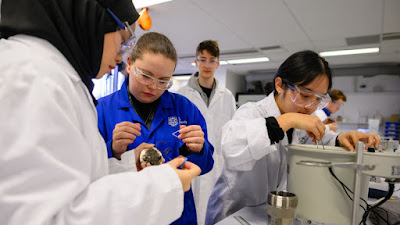
    Students in a Thermodynamics lab

    One of the most striking results was that students prefer shorter lab sessions. Just like attention drifts in lectures after about 20 minutes, lengthy lab sessions can lead to disengagement.

    The study suggests that two hours is the ideal maximum duration. Interestingly, students who enjoy labs are happy with the current length, while those who don’t would prefer shorter sessions.

    When it comes to group size, smaller is better. Both students and staff favour working in pairs. While some staff members find groups of three acceptable, students are less enthusiastic. The study found that groups of three tend to be less effective, possibly because one person may be left out. Groups of two or four seem to work best, likely depending on the experiment and equipment required. Notably, students who enjoy labs prefer smaller groups, while those who don’t tend to prefer larger groups. This highlights the importance of ensuring all students are actively engaged in the work.

    The Number of Labs: Quality Over Quantity?

    Surprisingly, most students are satisfied with the number of labs they have. Those who enjoy practical work would like more labs, while those who don’t would prefer fewer.

    Interestingly, some students who dislike labs still want more, possibly because they recognise their importance in engineering education. This suggests that the number of labs isn’t necessarily linked to whether students enjoy them.

    The study also highlights that group size should be flexible depending on the experiment and the level of the course. A one-size-fits-all approach may not be the best solution.

    What Does This Mean for Educators?

    It’s time to rethink how labs are structured. The key takeaways for educators are:

    1. Consider shorter lab durations, aiming for a maximum of two hours. Favour smaller groups, ideally pairs, but be flexible depending on the experiment.
    2. Ensure all students are actively engaged, avoiding group sizes where one person might be left out.
    3. Avoid reducing learning when reducing lab time or group sizes. Since lab duration and group size are resource-dependent, shortening sessions should be carefully managed to maintain educational value.

    Beck, Lazari, and Di Benedetti also examined ways to make lab time more efficient. One key recommendation is effective pre-lab activities to maximise hands-on time. Educators should also consider whether repetitive tasks are necessary and explore alternative methods like data pooling, allowing all students to fully participate. When expensive equipment is involved, a rotation system might be beneficial—letting one group use the resources while another discusses results with staff.

    The researchers even provide a practical equation explaining the relationship between lab duration, group size, and resource availability.

    The bottom line? Shorter labs with smaller groups can be just as effective as longer labs with larger groups while providing a better student experience.

    This study is a call to action for educators to rethink lab sessions, ensuring they are structured for maximum impact and engagement.

    You can check out the full paper by Beck, Lazari, and Di Benedetti here:

    Beck SB, Lazari P, Di Benedetti M. Lab group size and laboratory duration. International Journal of Mechanical Engineering Education. 2025;0(0). doi:10.1177/03064190251315693

    When citing this work, please use the following citation:
    Beck, S. Di Benedetti, M (2025). “
    Let’s Talk Labs: Making Practical Learning Work for Everyone” Centre for Engineering Education Blog, The University of Sheffield, Sheffield, UK. February 2025.