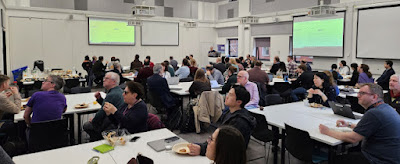
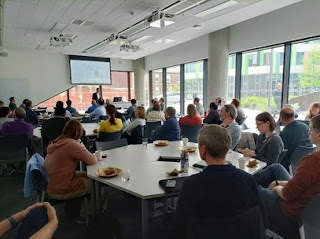
Varvara Papazoglou is a Teaching Associate in the School of Computer Science, University of Sheffield. In this post Varvara shares the work she led to investigate student perceptions of AI that found growing confidence, excitement and acceptance. The work was presented at the 18th annual International Conference of Education, Research and Innovation (ICERI 2025).
The study started during the academic year 2023-24 and was intended to track how the perceptions, expectations, and technical understanding of our undergraduate students shifted as they gained direct experience with GenAI technologies. With a team that included Alex Lucas and Prof. Rob Gaizauskas, we redesigned the first two lab sessions for a first-year module called Machines and Intelligence so that they included a practical introduction to Generative Artificial Intelligence (GenAI). Our study spanned two academic years, and tracked how the perceptions, expectations, and technical understanding of students shifted as they gained experience with GenAI technologies . To measure this, we invited volunteer participants from both cohorts to complete two online surveys, one before and one after engaging with the GenAI-focused curriculum of the module.
These questionnaires were administered three to four weeks apart, using unique IDs to match participant responses while preserving their anonymity. Structurally, they consisted of 13 core questions common to both iterations. Questions identified the specific GenAI tools students utilised and their typical purposes for doing so with, and 5-point Likert scales were used to evaluate viewpoints on GenAI’s performance, the identification of AI-generated content, and general feelings of excitement or concern. The perceived impact of AI on future careers, potential job obsolescence, and the ethics of GenAI use in university and workplace settings were explored. To ensure a comprehensive analysis, most of these questions included non-mandatory open-ended sections for qualitative insights, concluding with a final opportunity for participants to offer additional comments.
Testing Turing
The first lab focused on a practical adaptation of the Turing Test.
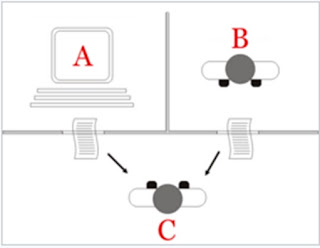
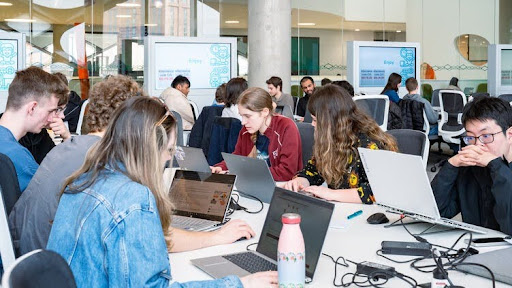
Students were split into groups of 6-7, paired with another group to play the roles of “interrogator” (C in Turing’s original formulation) and “interrogated” (both A (the man) and B (the woman/machine)) interchangeably.
To maintain anonymity and remove visual cues, all communication happened through a shared online document. The “interrogated” groups were tasked with choosing whether to provide the answers of an actual team member or to use ChatGPT or Gemini to produce human-like responses. The latter required students to act as prompt mediators; for example, they might instruct the model to adopt the persona of a 20-year-old first-year computer science student while keeping answers within a specific word count. This exercise forced students to grapple with the actual capabilities and flaws of these models. For their assessment, students submitted reflections on the following:
● As interrogators, whether they successfully identified the machine and what specific linguistic cues or mistakes led to that conclusion.
● As the interrogated group, whether they successfully deceived the interrogators into making the wrong identification, and whether this success was attributed to the AI’s capabilities or their own careful prompt engineering or other factors.
● Whether the Turing Test remains a valid benchmark for machine intelligence, based on their experience with the given task.
The second lab shifted towards the ethical and practical implications of AI in Higher Education. After reviewing online University resources regarding guidelines and policy on the use of GenAI, students analysed and critically evaluated 10 short descriptions of use cases on GenAI in Higher Education, split into two groups of five, involving use by educators and five use by students, ranging from AI-generated lecture content to code authoring with GenAI.
Groups debated the advantages and disadvantages of these scenarios, helping them develop an informed, critical perspective on how to use these tools responsibly throughout their degree.
Confidence, Excitement and Acceptance

To understand how these labs changed perspectives, we conducted pre- and post-task surveys, analysing 33 matched responses from the 2023-24 and 2024-25 cohorts. The results revealed the following in student literacy:
● Initially, students were fairly confident that GenAI could handle complex tasks. After the labs, this confidence actually dropped (from an average of 3.8 to 3.5 on a 5-point scale), suggesting that students gained a first-hand understanding of the inherent “hallucinations” and limitations.
● Student confidence in their ability to identify AI-generated content (based on cues such as unnatural or “over-polished” text) rose slightly, from an average of 3.2 to 3.5. Overall, as indicated by their responses to our survey questions, most participants had some experience and a good understanding of cues that can reveal GenAI output before our teaching interventions. However, among participants with no prior experience, greater confidence in recognising AI-generated material was observed.
● Interestingly, despite becoming more aware of the risks, students’ willingness to use GenAI in their studies increased (from 3.7 to 4.3). In addition, in their comments, students emphasised that, because GenAI tools and technologies are here to stay, the priority must be acceptance and education, so people are aware of how to use them effectively to maximise utility while minimising risk.
● While the media often portrays AI as a threat to jobs, our students largely viewed it as a transformation. Many saw the obsolescence of certain tasks not as a negative, but as an opportunity for new roles and increased productivity. Interestingly, students expressed similar feelings of excitement and acceptance for GenAI use in both Higher Education and the workplace.

Conclusion
Our findings suggest that early, structured engagement with GenAI, tied to subject-specific material, can foster more balanced and informed perspectives among students. Students with more awareness of risks and limitations seem to be more optimistic of the impact and potential of GenAI. However, we are mindful of the modest scope of our current research. Given the relatively small sample size and the specific context of our introductory module, these results serve as preliminary insights rather than definitive conclusions. We have identified areas for improvement, particularly in deepening students’ awareness of ethical and societal risks while reducing the likelihood that students feel overly confident about their ability to identify and manage AI-generated content without necessarily being aware of the full range of risks.
Varvara Papazoglou is a Teaching Associate in the School of Computer Science, University of Sheffield. Her research interests include Artificial Intelligence, Music Information Retrieval, Computational Linguistics and Natural Language Processing, as well as Educational Research in Computer Science.
When citing this work, please use the following citation:
Papazoglou, V. (2026). “Attitudes Towards Generative AI: A Study with First-Year Computer Science Students” Centre for Engineering Education Blog, The University of Sheffield, Sheffield, UK. June 2026. https://ceesheffield.co.uk/2026/06/09/attitudes-towards-generative-ai-a-study-with-first-year-computer-science-students/