Tag: Higher Education

  • Attitudes Towards Generative AI: A Study with First-Year Computer Science Students

    Varvara Papazoglou is a Teaching Associate in the School of Computer Science, University of Sheffield. In this post Varvara shares the work she led to investigate student perceptions of AI that found growing confidence, excitement and acceptance. The work was presented at the 18th annual International Conference of Education, Research and Innovation (ICERI 2025).

    The study started during the academic year 2023-24 and was intended to track how the perceptions, expectations, and technical understanding of our undergraduate students shifted as they gained direct experience with GenAI technologies. With a team that included Alex Lucas and Prof. Rob Gaizauskas, we redesigned the first two lab sessions for a first-year module called Machines and Intelligence so that they included a practical introduction to Generative Artificial Intelligence (GenAI). Our study spanned two academic years, and tracked how the perceptions, expectations, and technical understanding of students shifted as they gained experience with GenAI technologies . To measure this, we invited volunteer participants from both cohorts to complete two online surveys, one before and one after engaging with the GenAI-focused curriculum of the module.
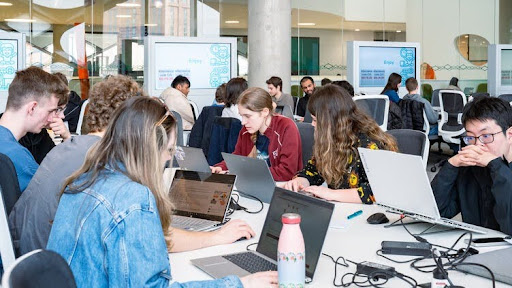
    Students on laptops in a classroom setting

    These questionnaires were administered three to four weeks apart, using unique IDs to match participant responses while preserving their anonymity. Structurally, they consisted of 13 core questions common to both iterations. Questions identified the specific GenAI tools students utilised and their typical purposes for doing so with, and 5-point Likert scales were used to evaluate viewpoints on GenAI’s performance, the identification of AI-generated content, and general feelings of excitement or concern. The perceived impact of AI on future careers, potential job obsolescence, and the ethics of GenAI use in university and workplace settings were explored. To ensure a comprehensive analysis, most of these questions included non-mandatory open-ended sections for qualitative insights, concluding with a final opportunity for participants to offer additional comments.

    Testing Turing

    The first lab focused on a practical adaptation of the Turing Test.
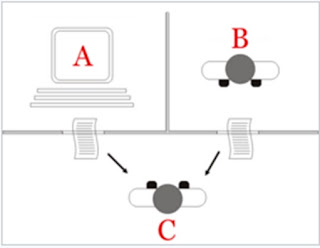
    Turing Test Diaghram

    Students were split into groups of 6-7, paired with another group to play the roles of “interrogator” (C in Turing’s original formulation) and “interrogated” (both A (the man) and B (the woman/machine)) interchangeably.

    To maintain anonymity and remove visual cues, all communication happened through a shared online document. The “interrogated” groups were tasked with choosing whether to provide the answers of an actual team member or to use ChatGPT or Gemini to produce human-like responses. The latter required students to act as prompt mediators; for example, they might instruct the model to adopt the persona of a 20-year-old first-year computer science student while keeping answers within a specific word count. This exercise forced students to grapple with the actual capabilities and flaws of these models. For their assessment, students submitted reflections on the following:

    ●      As interrogators, whether they successfully identified the machine and what specific linguistic cues or mistakes led to that conclusion.

    ●      As the interrogated group, whether they successfully deceived the interrogators into making the wrong identification, and whether this success was attributed to the AI’s capabilities or their own careful prompt engineering or other factors.

    ●      Whether the Turing Test remains a valid benchmark for machine intelligence, based on their experience with the given task.

    The second lab shifted towards the ethical and practical implications of AI in Higher Education. After reviewing online University resources regarding guidelines and policy on the use of GenAI, students analysed and critically evaluated 10 short descriptions of use cases on GenAI in Higher Education, split into two groups of five, involving use by educators and five use by students, ranging from AI-generated lecture content to code authoring with GenAI.

    Groups debated the advantages and disadvantages of these scenarios, helping them develop an informed, critical perspective on how to use these tools responsibly throughout their degree.

    Confidence, Excitement and Acceptance
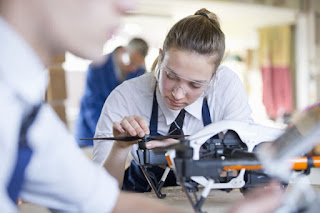
    Students working on a drone

    To understand how these labs changed perspectives, we conducted pre- and post-task surveys, analysing 33 matched responses from the 2023-24 and 2024-25 cohorts. The results revealed the following in student literacy:

    ●      Initially, students were fairly confident that GenAI could handle complex tasks. After the labs, this confidence actually dropped (from an average of 3.8 to 3.5 on a 5-point scale), suggesting that students gained a first-hand understanding of the inherent “hallucinations” and limitations.

    ●      Student confidence in their ability to identify AI-generated content (based on cues such as unnatural or “over-polished” text) rose slightly, from an average of 3.2 to 3.5. Overall, as indicated by their responses to our survey questions, most participants had some experience and a good understanding of cues that can reveal GenAI output before our teaching interventions. However, among participants with no prior experience, greater confidence in recognising AI-generated material was observed.

    ●      Interestingly, despite becoming more aware of the risks, students’ willingness to use GenAI in their studies increased (from 3.7 to 4.3). In addition, in their comments, students emphasised that, because GenAI tools and technologies are here to stay, the priority must be acceptance and education, so people are aware of how to use them effectively to maximise utility while minimising risk.

    ●      While the media often portrays AI as a threat to jobs, our students largely viewed it as a transformation. Many saw the obsolescence of certain tasks not as a negative, but as an opportunity for new roles and increased productivity. Interestingly, students expressed similar feelings of excitement and acceptance for GenAI use in both Higher Education and the workplace.

    Computer image of a face with letters coming out of it
    Conclusion

    Our findings suggest that early, structured engagement with GenAI, tied to subject-specific material, can foster more balanced and informed perspectives among students. Students with more awareness of risks and limitations seem to be more optimistic of the impact and potential of GenAI. However, we are mindful of the modest scope of our current research. Given the relatively small sample size and the specific context of our introductory module, these results serve as preliminary insights rather than definitive conclusions. We have identified areas for improvement, particularly in deepening students’ awareness of ethical and societal risks while reducing the likelihood that students feel overly confident about their ability to identify and manage AI-generated content without necessarily being aware of the full range of risks.

    Varvara Papazoglou is a Teaching Associate in the School of Computer Science, University of Sheffield. Her research interests include Artificial Intelligence, Music Information Retrieval, Computational Linguistics and Natural Language Processing, as well as Educational Research in Computer Science.

    When citing this work, please use the following citation:
    Papazoglou, V. (2026). “Attitudes Towards Generative AI: A Study with First-Year Computer Science Students” Centre for Engineering Education Blog, The University of Sheffield, Sheffield, UK. June 2026.
    https://ceesheffield.co.uk/2026/06/09/attitudes-towards-generative-ai-a-study-with-first-year-computer-science-students/
  • From Red Line Week to Engineering Education Scholarship Week: Why Taking Time Out Matters

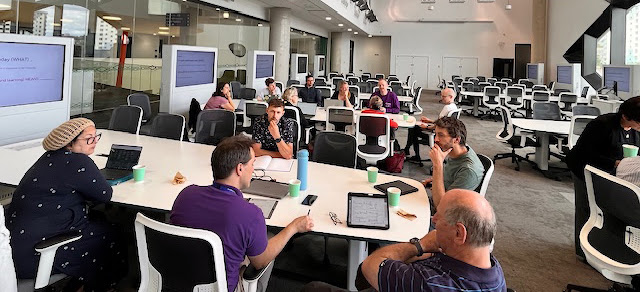
    University of Sheffield staff attending a Engineering Education session

    The Centre for Engineering Education is an initiative to support the educational aims of Engineering at The University of Sheffield, and open to all, and especially the many and varied people who support these aims. In this post Emma Kenny-Levick, a Senior Administration Officer at The University of Sheffield and super power behind the CEE blog, shares how scholarship led her to challenge her assumptions, and to make time for reflection that changed on her own practice.

    When I first joined Multidisciplinary Engineering Education (MEE), a recurring block of events appeared in my calendar titled “Red Line Week.” I didn’t really know what it meant. I knew it was something to do with scholarship and personal development, two terms that, at the time, felt distant from my day‑to‑day role. I was new, busy and focused on learning the practical realities of my job. Taking time out to think about scholarship didn’t feel relevant.

    I was a professional services member of staff so why was scholarship relevant to me?

    So, like many others across the Faculty of Engineering might have done, I ignored it. I didn’t read the emails. I didn’t consider attending the sessions. Not even when hot refreshments, pastries and lunch were offered.

    If only I’d known then what I understand now.

    With hindsight, I can see clearly what Red Line Week was always intended to be and why it has become such a valuable part of our engineering education community today, now known as Engineering Education Scholarship Week (EESW).

    Drawing a line through the working week

    Red Line Week was developed and championed by Dr Matteo Di Benedetti, Senior University Teacher in MEE and Co‑Director of the Centre for Engineering Education (CEE). The idea was simple: draw a red line through your work calendar and use that protected time to focus on your own development.

    At the time, I associated development with formal training courses or mandatory requirements, not with taking space to think, reflect, write or talk with others about how I did my job and how I could do it better.

    And I certainly didn’t see how scholarship related to me.

    “What is scholarship and what has it got to do with my role?”

    For me, scholarship felt abstract. It sounded academic, theoretical, something for university teachers, not for someone in professional services.

    It wasn’t until my third year in MEE that something shifted. I looked more closely at the programme and spotted a session on effective evaluation, something directly relevant to my work. I decided to attend.

    That was the moment the penny dropped.

    I realised that scholarship wasn’t about doing something extra or becoming someone different. It was about developing ideas to improve practice. About taking what you do every day and looking at it more critically with the aim of making it better. Scholarship wasn’t separate from my role, it strengthened it.

    Space to think, not just sessions to attend

    What I came to understand is that EESW isn’t just about workshops or keynotes, though those matter. It’s about creating space.

    Space to sit in a room with like‑minded people.
    Space to reflect on what works (and what doesn’t).
    Space to talk openly about teaching, learning, evaluation, identity and confidence.

    Over time, the programme has grown from strength to strength. What began as Red Line Week has evolved into a rich programme that now includes:

    ●      Keynotes and workshops on engineering education, scholarship, academic identity, writing and open practices

    ●      Engineering and Teaching Shorts (EATS)

    ● Education Themed Networks (ETNs) bringing colleagues together around shared interests

    ●      Dedicated scholarship spaces for focused thinking, discussion and writing

    ●      Sessions delivered in partnership with colleagues from across the University, including Elevate and Student Support

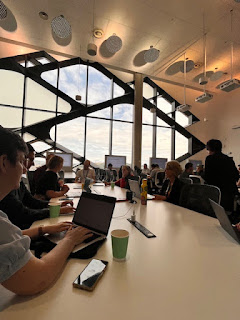
    University of Sheffield staff attending a Engineering Education session

    Crucially, EESW welcomes academics, researchers, GTAs, professional services and technical colleagues. It recognises that improving engineering education and the student experience, is a shared endeavour.

    Seeing the value of time taken out

    Now, when I see EESW in my calendar, I see it very differently.

    I see the benefit of stepping away from routine tasks to think about what I do and how I might do it better. I see how confidence grows when people realise that their experiences and ideas matter. And I see how investing time in staff development feeds directly into stronger teaching, better support services and richer learning for students.

    I also see something else: permission.

    Permission to slow down.
    Permission to reflect.
    Permission to invest in yourself without feeling that you should be doing something else.

    In a sector that often feels pressured and reactive, having structured, protected time like this is not something to take for granted.

    Why I wish more people would give it a try

    If you’ve ever looked at EESW (or Red Line Week, as it once was) and thought, ‘this isn’t for me’, I understand that reaction as I had it too.

    But my experience has taught me that taking time out for personal and professional development isn’t a luxury, it’s a necessity. It sustains good practice and strengthens not only how we work but how we work together.

    Engineering Education Scholarship Week is, at its heart, about people: their ideas, their growth and the space to develop both.

    If you’re curious about what that looks like in practice, here are a couple of highlight videos from past programmes:

    ●      Why Engineering Education Scholarship week and the benefits of attending

    ●      EESW July 2025 Highlights Video

    ●      EESW January 2026 Highlights Video

    And if you’re on the fence next time it appears in your calendar, my advice is simple: draw the red line and see what happens.

    When citing this work, please use the following citation:
    Kenny-Levick, E (2026). “From Red Line Week to Engineering Education Scholarship Week: Why Taking Time Out Matters” Centre for Engineering Education Blog, The University of Sheffield, Sheffield, UK. May 2026. https://ceesheffield.co.uk/2026/10/27/redlineweek/

  • Becoming Comfortable with Black Box Engineering

    In this article, Professor Andrew Garrard from the University of Sheffield and Dr Parakram Pyakurel from New Model Institute for Technology and Engineering discuss whether engineering education’s traditional resistance to “black box” thinking remains fit for purpose. As simulation software, Industry 4.0 methods, and generative AI make it harder for engineers to understand the tools they use, is it time to take a pragmatic approach in education and consider black box engineering not as a threat to be resisted, but as an inevitability to be acknowledged?

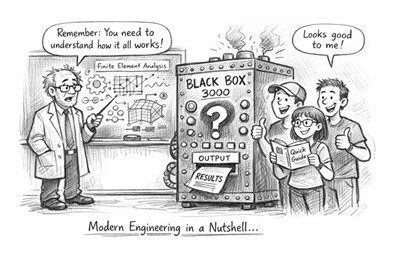
    cartoon of modern engineering in a nutshell

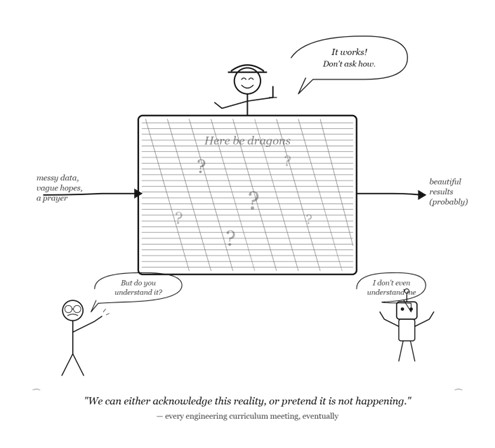
    Cartoon images generated by AI using the prompt “Please can you read this article and come up with a simple pencil drawing cartoon that makes light of the general themes of the piece?”. This image was created using Open AI’s ChatGPT 5.4.

    There is a widely held belief amongst engineering educators that students should be discouraged from relying on a “black box” approach to engineering; that is, producing results using methods and tools with little or no understanding of how they work. Moreover, it can be considered dangerous to certify a graduate as competent if they accept, on faith, the validity of results generated by means they do not understand.

    To what extent, however, is this view an anachronism, tightly clung to by academia but no longer reflective of real-world engineering practice?

    Cartoon images generated by AI using the prompt “Please can you read this article and come up with a simple pencil drawing cartoon that makes light of the general themes of the piece?”. This image was created using Anthropic’s Opus 4.6.

    Consider, for example, predicting how a system will behave through engineering simulation, such as by using the finite element method. In previous generations, it was conceivable that engineers could build, from the ground up, the software required to perform finite element calculations. This was possible because the limits of computational power meant that only relatively simple systems could be analysed using comparatively straightforward numerical techniques.

    Fast forward to today, and modern engineering simulation software can consist of hundreds of gigabytes of code and mind-bogglingly complex algorithms designed to optimise every stage of the process. Take the generation of computational meshes. In the past, engineers constructed meshes manually, deciding the position of nodes and connecting them together with lines. Today, powerful automated meshing algorithms generate highly complex meshes as part of a largely turnkey process.

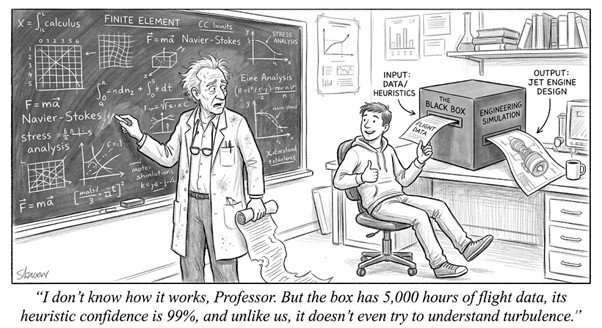
    It is unrealistic to expect engineering students, who are learning multiple topics across a wide range of domains, to understand the detailed inner workings of every piece of software they use. As the ability to understand precisely what engineering simulation software is doing has diminished, it has been replaced by an increased emphasis on heuristics: I chose this turbulence model because experience suggests it performs well for this type of fluid flow.

    Cartoon depicting black box engineering

    Cartoon images generated by AI using the prompt “Please can you read this article and come up with a simple pencil drawing cartoon that makes light of the general themes of the piece?”. This image was created using Google’s Gemini 3.1

    The same “black box” approach underpins many aspects of Industry 4.0, and more recently Industry 5.0. Rather than fully understanding the physical mechanisms governing the dynamics of engineering systems, sufficiently large datasets can be used to predict outcomes accurately through sophisticated statistical methods.

    The world is already full of black-box engineering, and this trend is only likely to accelerate with the rapid advancement of artificial intelligence. While it may be extremely challenging to fully understand all the methods used in modern, complex engineering software, the algorithms involved are at least deterministic. By contrast, the stochastic outputs of Generative AI, like large language models, means that determining how they will respond to any given input is not something anyone can reliably predict, even those who have built the models. As AI becomes increasingly embedded within software products, additional opaque layers will accumulate, making it ever more difficult to truly understand what the computer is doing.

    Whether the adoption of a “black box” approach to engineering is desirable remains open to debate. What seems less debatable, however, is its inevitability in the modern world. We can either acknowledge this reality, or pretend it is not happening.

    Once we admit this – what are the implications?

    The increasing complexity of computational methods, together with the advent of AI systems whose behaviour can be difficult to fully understand, may appear to be a distinctly modern problem. However, making predictions about how systems will behave with limited understanding of the underlying governing principles has long been the standard approach of empiricists.

    Often attributed to Heisenberg is the quote:

    “When I meet God, I am going to ask him two questions: Why relativity? And why turbulence? I really believe he will have an answer for the first.”

    As a species, we remain unable to analytically calculate turbulent flow. Yet engineers are able to model aeroplanes, pipelines, and wind turbines with impressively high precision. While imparting conceptual understanding of fundamental engineering principles is important, we may be overlooking opportunities to train students in data analysis, interpretation, and subsequent processing.

    As educators, our task is to equip students with the understanding and tools necessary to have a positive impact on the world. In already crowded engineering curricula, content must compete for inclusion among the many topics considered essential for an undergraduate programme. If complexity, big data, and stochastic computation are becoming commonplace, is there a need to shift some emphasis away from traditional physical sciences toward statistics, empiricism, and validation?

    When citing this work, please use the following citation:
    Garrard, A & Pyakurel, P. (2026). “Becoming comfortable with black box engineering”. Centre for Engineering Education Blog, The University of Sheffield, Sheffield, UK. March 2026. https://ceesheffield.co.uk/2026/10/27/blackboxengineering/

  • Introducing Practice Exchange & Partnerships

    The Centre for Engineering Education (CEE) supports, promotes, and celebrates the outstanding teaching within the Faculty of Engineering. Laura Neasmith introduces an exciting new initiative designed to connect our experts with external organisations. Read on to discover how Practice Exchange and Partnerships are set to empower our community and further enhance our commitment to excellence in engineering education.

    At the Centre for Engineering Education (CEE) in the Faculty of Engineering, we’re all about supporting teaching staff and Graduate Teaching Assistants (GTAs) to deliver exceptional teaching and create a fantastic student experience. Our goal? To make Sheffield an acknowledged leader in engineering education.That’s why we’ve evolved our approach to external engagement into something more powerful: Practice Exchange & Partnerships. Through this work, CEE connects educators, researchers and external partners to share ideas, test new approaches and shape the future of engineering education together.

    Whether you’re looking for a keynote speaker, an expert advisor, or a partner for educational innovation, CEE can help you connect with the right people across the Faculty of Engineering.

    What is a Practice Exchange?

    Practice Exchange is at the heart of what we do. It creates space for educators to learn from one another — within Sheffield and beyond — by sharing real teaching challenges, emerging ideas and practical innovations.

    These exchanges can take many forms:
    from visiting speakers and informal discussion events, to joint workshops, international visits and longer-term collaborations that lead to new projects and research.

    The aim is simple but powerful: to bring people together around teaching practice, so that new ideas can be explored, refined and taken forward in a supportive, open environment.

    Practice Exchange in Action: Building connections

    Back in 2025, CEE launched a collaboration with Sheffield Hallam University to bring together engineering educators from across the city.

    Two informal Practice Exchange events created space for colleagues to share teaching ideas, explore common challenges and learn from one another. The first, hosted in The Diamond, featured short talks on topics including bioengineering labs, spreadsheet-based finite element analysis, inclusive teamwork and Multidisciplinary Engineering Education Project Weeks. These sparked lively conversations about how similar approaches could work in different contexts.

    A reciprocal event at Sheffield Hallam continued the dialogue, introducing ideas such as low-fidelity simulations for lab preparation and digitally enhanced learning activities.

    Participants valued the chance to meet peers working on similar problems and to build relationships beyond their own institutions — showing how powerful early-stage sharing can be in generating new collaborations and fresh approaches to teaching.

    CEE also hosts international Practice Exchange visits. Again in 2025, the Centre welcomed Dr Darson Li from the University of New South Wales for a two-day exchange focused on engineering education and curriculum innovation.

    During his visit, Dr Li met educators from across the Faculty and explored how teaching and learning happens in The Diamond — from design and make spaces to aerospace projects and engineering design teaching. These conversations allowed both sides to compare approaches and identify shared interests.

    He also delivered a well-attended EATS lunchtime seminar on using file metadata to help detect plagiarism, sparking new discussions and opening up future collaborative opportunities. Follow-up conversations are already under way, with plans for joint educational research and further exchanges.

    Our Specialist

    CEE works with a wide network of education-focused staff across the Faculty, including:

    • Principal Fellows of the HEA
    • National Teaching Fellows
    • Academic leads in engineering education
    • Specialists in curriculum design, assessment, inclusion and digital learning

    Together, this community brings deep expertise in how engineering is taught, learned and experienced by students

    Why This Matters?

    Engineering education is changing fast — with growing emphasis on hands-on learning, inclusive practice, digital innovation and strong links between universities and industry.

    Practice Exchange & Partnerships helps Sheffield stay at the forefront of those changes by creating meaningful connections that lead to better teaching, stronger curricula and richer student experiences.

    If you’re interested in collaborating, learning from our educators, or exploring what a partnership might look like, we’d love to hear from you.

    Contact us at: cee@sheffield.ac.uk

    When citing this work, please use the following citation:

    Neasmith, L. (2025). “Introducing Practice Exchange and Partership”. Centre for Engineering Education Blog, The University of Sheffield, Sheffield, UK. October 2025. https://ceesheffield.co.uk/2026/10/29/introducing-practice-exchange-partnerships/