Tag: iForge

  • Celebrating over a Decade of Impact at The Diamond

    In this reflective piece, Sophie Barwick takes us through the special 10-year celebration of the Diamond building —now firmly established as the heart of engineering education at the University of Sheffield. From cutting-edge labs and inspiring staff, to the student-driven innovation of the iForge, Sophie shares how the Diamond has shaped her journey as both a student and GTA. Her insight captures the building’s enduring purpose: a space built for students, enriched by community, collaboration, and hands-on learning.
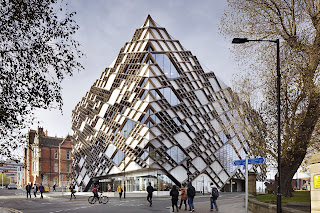
    Exterior of the diamond building

    Back in October 2025, the Diamond opened its doors to staff, students, alumni and visitors to celebrate 10 years of the Diamond building. Over this time the Diamond building has become a fundamental place for the education of thousands of engineering students at the University of Sheffield. The range of state of the facilities, enthusiastic staff and open study spaces make it a great place to learn and develop skills.

    The Diamond building offers a range of laboratories and lecture theatres to teach students engineering concepts from across all disciplines under one roof, marking it as the flagship teaching facility for the faculty. It therefore also enables students to have a base to explore new concepts and work together, particular crucial for those new to university and Sheffield.

    In addition to timetabled teaching, key part of the student experience in the diamond is the iForge – the UK’s first student-led makerspace. This facility allows both engineering and students from across the university to make their ideas reality while learning practical skills and, for those selected as iForge representatives, an opportunity to develop their teaching and leadership skills as well.

    Staff from a range of academic and industrial backgrounds form a team of teaching and support staff within the department of Multidisciplinary Engineering Education which is supportive, encouraging and enthusiastic about engineering education. The staff, primarily based in laboratories, teach students from a range of engineering disciplines and levels of study with the support and guidance relevant for their background. They also work throughout the year adapting lab activities to ensure they align with module content and current technologies.

    The Faculty of Engineering are able to offer and teach the activities to so many students in the diamond thanks to the assistance of graduate teaching assistants (GTAs). Often graduates from undergraduate courses at the University of Sheffield themselves, GTAs are current PhD students with expertise to help and guide students in each of the laboratories, increasing the staff to student ratio, and therefore better supporting the students.

    I was honoured to be invited as a guest on the “Student Experience” panel for the Decade of the Diamond celebration event. The Diamond building, and the facilities within it, have been fundamental to my development during my time at the University of Sheffield and it was great to be able to offer insight into my experience in as both a student and GTA in the Faculty of Engineering, University of Sheffield.

    It’s fantastic to see the student voice continue to be so actively involved in the continued evolution of the Diamond. After all, as Professor Stephen Beck said “the Diamond is and always was a building designed for the students”.
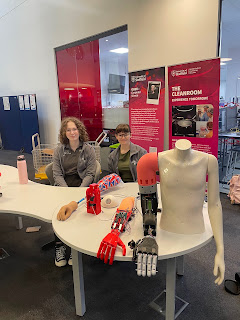
    Robotic arm on an exhibition stand

    In addition to the student voice session, the celebration event heard from many speakers key to the development of the Diamond building and the teaching within it, including the original architects from Twelve Architects,
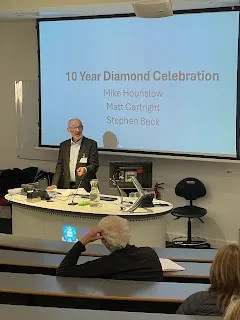
    Mike Hounslow delivering an opening address

    Professor Stephen Beck, the founding Head of Multidisciplinary Engineering Education, and Professor Emeritus Mike Hounslow, Pro Vice-Chancellor for Engineering during the construction. They reflected on the development of the Diamond from its original conception to how to it is still developing today.

    Sir John Lazar CBE FREng, president of the Royal Academy of Engineering, and representatives from across industry offered insight into how the Diamond building develops well-rounded engineering graduates, equipped with the skills they need for their future careers.

    Sir John Lazar CBE FREng, president of the Royal Academy of Engineering, and representatives from across industry offered insight into how the Diamond building develops well-rounded engineering graduates, equipped with the skills they need for their future careers.

    Throughout the day, in the Moonscape study area, there was stalls displaying the fantastic work of both the diamond laboratories and each of the schools in the faculty of engineering. There were also talks from many of the schools reflecting on the opportunities they offer students, with particular focus on inclusivity and accessible research and learning tools.

    The day also allowed for many opportunities to network with members of current and previous staff who have helped shape MEE, as well as those crucial in the realisation of the Diamond building itself.

    Many thanks to Harry Day, Emma Kenny-Levick, Andrew Garrard, and all involved in organising the event – I look forward to the next one!

    When citing this work, please use the following citation:

    Barwick, S. (2025). “Celebrating a Decade of Impact at The Diamond”. Centre for Engineering Education Blog, The University of Sheffield, Sheffield, UK. January 2026. https://ceesheffield.co.uk/2026/10/27/celebratingimpact/
  • From Sheffield to India: Expanding Makerspace Partnerships and Engineering Education

    From Sheffield to India: Expanding Makerspace Partnerships and Engineering Education

    During a recent visit to India, Dr Pete Mylon explored new partnerships with leading institutions, sharing insights on student-led makerspaces like the iForge in Sheffield and practical learning. In this blog, he reflects on his experience and the exciting opportunities ahead, and how international collaboration is key to advancing engineering education.

    Mumbai and IITs

    The first order of business was to meet Hemant Kanakia, Chair of Maker Bhavan Foundation (MBF), who fund and support makerspaces at Higher Education Institutes across India. We have been developing an idea for an international student competition that will capitalise on the makerspace facilities now available at many institutions and allow for an exchange of ideas between students from different contexts.

    Together, I travelled with Hemant to IIT Bombay. The IITs were established in the 1950s and 60s and are amongst some of the top institutions globally for Engineering. Sheffield has formed a strategic partnership with IIT Bombay, and so I was able to apply to the Partnership Development Fund to support this collaboration.

    At the campus, I met with Siddarth Tallur, who oversees their electronics makerspace, and Pratik Mutha from IIT Gandhinagar, who is in charge of the makerspace there.

    workshop activity

    It was great to share our experiences and to see many similarities in the challenges we faced, and there was much enthusiasm for a collaborative competition.

    Having successfully run Hackcessible at Sheffield for a number of years, and with assistive technology also an area of interest for a number of academics in the IITs, we decided on this as a theme and discussed some ideas for the logistics, with the intention for students from India to visit the UK and vice versa. We left with actions to follow up with our own institutions to firm up timings and funding, but mainly with excitement about the potential for all of our students to have an enriching experience.

    While there, I looked around the Experiential Learning Lab (ELL), a curricular makerspace for EEE students, where they have made some great creative mechatronic projects.

    Table with tools on

    I met a couple of their technical staff who had come to Sheffield for ISAM and were really impressed with the iForge facilities. I was also able to speak to some of their students about their experiences. At the end of the afternoon, I headed to the airport, bound for Delhi.

    Delhi

    In Delhi, I had arranged some meetings at IIT Delhi and with MBF directors and donors but had a free day beforehand. So, I arranged with the University of Sheffield’s India office to visit some ‘counsellors’—agents who support Indian students applying to Sheffield and other international institutions. We briefed counsellors, outlining Sheffield’s USP as a practical Engineering experience and what the Diamond facilities, iForge, and co-curricular activities offer students. There was particular interest in Aerospace Engineering, with India having recently made advances in their national space programme, and students were excited by the achievement of Project Sunride.

    Hemant Kanakia had arranged for us to meet Jay Dhariwal, Director of the IIT Delhi Makerspace, and next on the itinerary was a visit to his maker space and some of his staff.

    They were to be found in a brand new building and are in the process of growing a student community by running workshops, but were keen to learn about student-led makerspaces and how the iForge in Sheffield runs.

    Laser cutter

    Jay said, “It was good to learn from you about how the student-led makerspace came about and is running well at your university, the importance of community building, having flavours of creative explorations and problem-solving at your Makerspace, and all the exciting projects that the student clubs are building at the University of Sheffield—from rocketry to biomedical devices to projects in the sustainability realm and more.”

    Mumbai

    Pete Mylon with a Mumbai academic

    In Mumbai we connected with a delegation from Sheffield that included academics from Engineering and the Vice Chancellor. We visited IIT Bombay to strengthen the strategic partnership we have built and met with a number of academics, including IIT Bombay’s Director.

    Whilst there, I also managed to see another couple of makerspaces—the main ‘MakerSpace’ runs introductory courses for over 1400 students who make projects like drones and line follower robots, but is more akin to our taught Diamond laboratories.

    The Tinkerers’ Lab, funded by MBF, has more of a student-led feel, although it is supervised by technical staff. Students are free to work on whatever projects they like, either for curriculum work or personal projects.

    Group picture of students and Pete Mylon in a workshop

    It was great to connect with Damayanti Bhattacharya, MBF’s CEO, and chat about their vision to see makerspaces established in many more HEIs.The trip ended at the Taj Lands End, overlooking the Arabian Sea, for a University of Sheffield alumni reception, hosted by the VC and organised by Hayley Chalmers from CAR. It was great to chat with alumni and supporters of the University and help to maintain a strong alumni community.

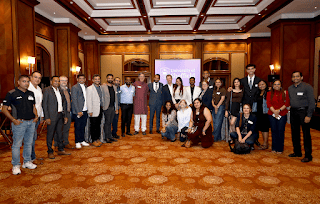
    Group picture of Indian delegation

    Now the real work begins as I work on the partnerships developed during the trip, and there should be a number of exciting collaborations over the coming months!

    When citing this work, please use the following citation:
    Mylon, P (202). “
    From Sheffield to India: Expanding Makerspace Partnerships and Engineering Education” Centre for Engineering Education Blog, The University of Sheffield, Sheffield, UK. March 2025. https://ceesheffield.co.uk/2026/10/29/from-sheffield-to-india-expanding-makerspace-partnerships-and-engineering-education/