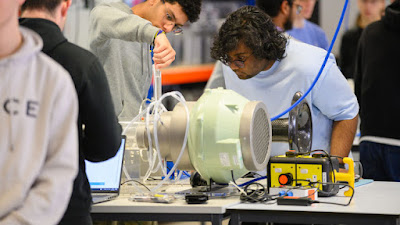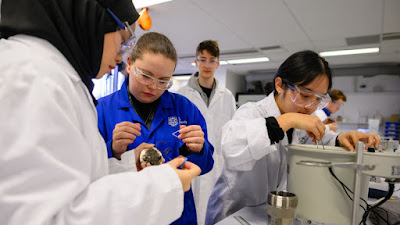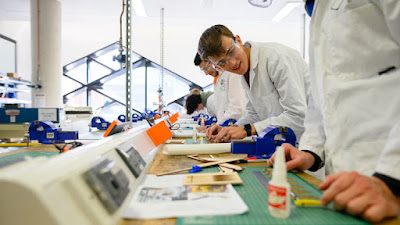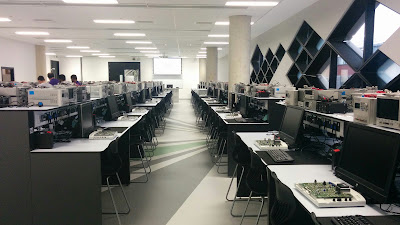
The size of a class has impact on learners, learning and the expectations of learners, and recent Centre for Engineering Education publications confirm this to be the case for Lab classes. Here Stephen Beck shares his insight into how to plan and run great lab classes on scale, but also the scholarly process in engineering education, and sometime the answers are at home.
Many of the experiments that take place in engineering labs have an online alternative assessment which students can complete if they are unable to attend labs. Many courses have labs, but not marks associated with them, so incentives to attend can be low, even though labs form a valuable opportunity for learning and can be integral to the courses. There is great educational value for students who participate in the labs, so we asked the question : Why do students choose to attend labs or skip labs? By finding the answer we could work out how to make them more enticing.
We used questionnaires to collect data because we have found it to be an effective approach in the past, and used it as an opportunity to ask staff what they thought labs were for.
Reviewing the literature turned out to be more difficult than I’d assumed; I couldn’t find anything on students NOT attending labs. There were plenty of papers on labs themselves, and a number stating that lab attendance improved student performance [1]. Fortunately, my daughter (who is a social scientist) was at home at the time and when I lamented about not finding anything useful, she suggested that I search for why students DO attend laboratories. Still nothing…so after a further discussion, I looked for literature for why students attend lectures, and this revealed a collection of useful papers [2]. By learning from the educational research in social science, engineering educators have much to gain. In fact, educational research demands many development of new skills to be effective in this research field by most engineers. Engaging with social scientists is therefore vital! In the faculty of Engineering at Sheffield, a route to this expertise (and co-authorship) is via Sarah Plump in Elevate (the University’s learning and teaching educators) and Tim Herrick from the School of Education, particular in the design and analysis of qualitative and quantitative data.
The literature showed that the main reasons why students don’t attend lectures are: because they are unwell (often hungover), do not think that it is a good use of their time (either they don’t need the learning or they can get it more effectively elsewhere) and that they have other, more pressing, assignments or work to do. Essentially, this is what we found for labs.
Our research led to interesting insights into student and staff perception of what they thought labs were for. It is clear that staff and students agree on the top two reasons for attending (reinforcing lecture material and the practical experience) (Figure 1). Staff were also asked why they thought students attended labs. Here the top answers were, ‘To get a practical experience’, followed by ‘To get marks’ and ‘Part of any engineering course’ which contrasted with the students with regards to the latter two responses. This mismatch is interesting as staff may not be using reasons that resonate with students to encourage them to attend laboratory sessions. Again the literature shows that Staff encouragement is a key tool in encouraging attendance.

Additional questions on lab group size and lab duration showed that students like short labs and small groups. At Sheffield, we have been optimising our labs for student learning and experience. Most are now two hours or less. When creating laboratories, it is really important to clarify about what is to be in each experiment and what students will actually get out of them. Do students need to do a lot of repetitions? Can the students do more of the activities outside the actual labs? Student learning and experience is supported by formal prelab preparation that contains theory, introduction to the equipment, and the Health and Safety required. In many cases, with a compulsory introduction taking place outside the laboratory, students can be using the equipment within 5 minutes of the session starting. We have also moved much of the work that students do after the lab away from the valuable laboratory space.
With the wind in our sails and confidence in the quality of our work we wrote it up into a 10,000 word article that got rejected (very rapidly) by journals on three continents. So, we submitted it to a fourth journal who liked the work, but said it was too long. Rather than reducing the detail in the paper, we decided to split it in two. The first one was on why students attend (or don’t attend) labs which appeared about 6 months ago in the first volume of the new SEFI Journal of Engineering Education Advancement [3] and the second one was based around lab group size and duration which has just appeared in The International Journal of Mechanical Engineering Education, why not have a look at it?
The main findings here are that generally students like shorter labs and small groups. These can best tied in with another recent publication [4]. Here we looked at lab utilisation and why sharing of labs is a good thing for a variety of reasons (figure 2).

This approach meant that I could produce an equation

D is the lab duration, G the size of the group. This shows that for the same lab use, if we have smaller groups and shorter labs, we can get the same number of students through. According to our research, this should give better student satisfaction.
So by thinking about student and staff expectation of labs, lab utilisation and planning, you can improve the student experience within the same resource model. Why not try this yourselves?
When citing this work, please use the following citation:
Beck, S (2025). “Laboratory Size and Student Expectations – publishing educational research and the scholarship process” Centre for Engineering Education Blog, The University of Sheffield, Sheffield, UK. May 2025. https://ceesheffield.co.uk/2026/10/29/laboratory-size-and-student-expectations-publishing-educational-research-and-the-scholarship-process/
Further Reading
[1] Greco, E., & Reasoner, J. (2010, June), Student Laboratory Skills And Knowledge Improved Through Individual Lab Participation Paper presented at 2010 Annual Conference & Exposition, Louisville, Kentucky. 10.18260/1-2–16568
[2] Friedman, Paul, Fred Rodriguez, and Joe McComb. Why students do and do not attend classes: Myths and realities. College teaching 49.4 (2001): 124-133.
[3] Beck, S., Lazari , P., & DiBenedetti , M. (2024). Why do engineering students attend labs? Staff and student reasons for lab attendance, desired group size and number of laboratories. SEFI Journal of Engineering Education Advancement, 1(1), 26–37. https://doi.org/10.62492/sefijeea.v1i1.17.
[4] Beck S. On having the right size laboratories. International Journal of Mechanical Engineering Education. 2023;51(2):111-122. doi:10.1177/03064190221142347