Tag: multidisciplinary engineering

  • Celebrating over a Decade of Impact at The Diamond

    In this reflective piece, Sophie Barwick takes us through the special 10-year celebration of the Diamond building —now firmly established as the heart of engineering education at the University of Sheffield. From cutting-edge labs and inspiring staff, to the student-driven innovation of the iForge, Sophie shares how the Diamond has shaped her journey as both a student and GTA. Her insight captures the building’s enduring purpose: a space built for students, enriched by community, collaboration, and hands-on learning.
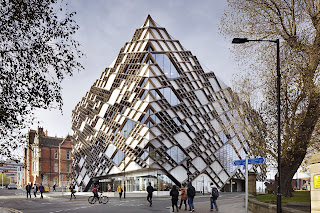
    Exterior of the diamond building

    Back in October 2025, the Diamond opened its doors to staff, students, alumni and visitors to celebrate 10 years of the Diamond building. Over this time the Diamond building has become a fundamental place for the education of thousands of engineering students at the University of Sheffield. The range of state of the facilities, enthusiastic staff and open study spaces make it a great place to learn and develop skills.

    The Diamond building offers a range of laboratories and lecture theatres to teach students engineering concepts from across all disciplines under one roof, marking it as the flagship teaching facility for the faculty. It therefore also enables students to have a base to explore new concepts and work together, particular crucial for those new to university and Sheffield.

    In addition to timetabled teaching, key part of the student experience in the diamond is the iForge – the UK’s first student-led makerspace. This facility allows both engineering and students from across the university to make their ideas reality while learning practical skills and, for those selected as iForge representatives, an opportunity to develop their teaching and leadership skills as well.

    Staff from a range of academic and industrial backgrounds form a team of teaching and support staff within the department of Multidisciplinary Engineering Education which is supportive, encouraging and enthusiastic about engineering education. The staff, primarily based in laboratories, teach students from a range of engineering disciplines and levels of study with the support and guidance relevant for their background. They also work throughout the year adapting lab activities to ensure they align with module content and current technologies.

    The Faculty of Engineering are able to offer and teach the activities to so many students in the diamond thanks to the assistance of graduate teaching assistants (GTAs). Often graduates from undergraduate courses at the University of Sheffield themselves, GTAs are current PhD students with expertise to help and guide students in each of the laboratories, increasing the staff to student ratio, and therefore better supporting the students.

    I was honoured to be invited as a guest on the “Student Experience” panel for the Decade of the Diamond celebration event. The Diamond building, and the facilities within it, have been fundamental to my development during my time at the University of Sheffield and it was great to be able to offer insight into my experience in as both a student and GTA in the Faculty of Engineering, University of Sheffield.

    It’s fantastic to see the student voice continue to be so actively involved in the continued evolution of the Diamond. After all, as Professor Stephen Beck said “the Diamond is and always was a building designed for the students”.
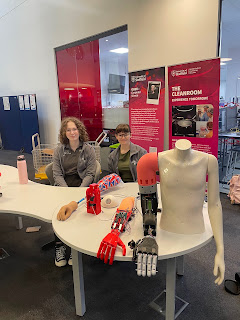
    Robotic arm on an exhibition stand

    In addition to the student voice session, the celebration event heard from many speakers key to the development of the Diamond building and the teaching within it, including the original architects from Twelve Architects,
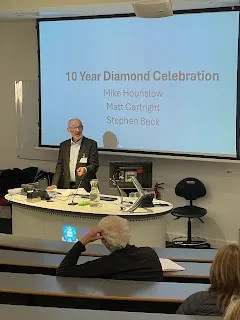
    Mike Hounslow delivering an opening address

    Professor Stephen Beck, the founding Head of Multidisciplinary Engineering Education, and Professor Emeritus Mike Hounslow, Pro Vice-Chancellor for Engineering during the construction. They reflected on the development of the Diamond from its original conception to how to it is still developing today.

    Sir John Lazar CBE FREng, president of the Royal Academy of Engineering, and representatives from across industry offered insight into how the Diamond building develops well-rounded engineering graduates, equipped with the skills they need for their future careers.

    Sir John Lazar CBE FREng, president of the Royal Academy of Engineering, and representatives from across industry offered insight into how the Diamond building develops well-rounded engineering graduates, equipped with the skills they need for their future careers.

    Throughout the day, in the Moonscape study area, there was stalls displaying the fantastic work of both the diamond laboratories and each of the schools in the faculty of engineering. There were also talks from many of the schools reflecting on the opportunities they offer students, with particular focus on inclusivity and accessible research and learning tools.

    The day also allowed for many opportunities to network with members of current and previous staff who have helped shape MEE, as well as those crucial in the realisation of the Diamond building itself.

    Many thanks to Harry Day, Emma Kenny-Levick, Andrew Garrard, and all involved in organising the event – I look forward to the next one!

    When citing this work, please use the following citation:

    Barwick, S. (2025). “Celebrating a Decade of Impact at The Diamond”. Centre for Engineering Education Blog, The University of Sheffield, Sheffield, UK. January 2026. https://ceesheffield.co.uk/2026/10/27/celebratingimpact/
  • Taking the leap into Scholarly Activity

    Taking the leap into Scholarly Activity

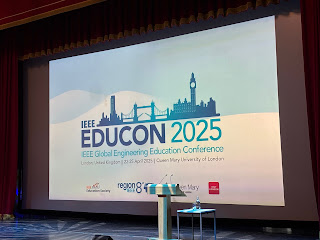
    Educon 2025 Presentation Slide

    What does it feel like to step into the world of academic conferences for the first time—not as a spectator, but as a speaker? For Laura Neasmith, it was a journey that began with hesitation and ended in confidence. At this year’s IEEE EDUCON, Laura shared research rooted in her MSc study on collaboration across staff roles in Multidisciplinary Engineering Education (MEE). In this blog, she reflects on the experience of presenting at an international conference, what she learned from others, and why professional services voices matter in engineering education.

    I confess that when I was initially encouraged to submit an abstract to the Institute of Electrical and Electronics Engineering (IEEE) conference, EDUCON, I was fairly confident that it would never be accepted and saw it more as part of a learning process of entering into scholarly activity. As someone not from a traditional academic background, imagine my surprise when the abstract was accepted, and a paper was then needed to accompany it. I had to accept that I was going to be attending my first ever academic conference as a contributor rather than an attendee.

    Exploring collaboration in MEE

    My submission was based on MSc research I had completed the year before, which explored interprofessional collaboration between staff groups within Multidisciplinary Engineering Education (MEE). I was particularly curious about how these collaborative efforts might influence the professional identity of the staff involved. At MEE, academic, technical, and administrative staff work together to co-deliver teaching in the labs, a model that is quite different from traditional teaching delivery and I wanted to understand how this unique setup might shape how staff perceive their roles.

    To explore this, I conducted interviews with members of the team and carried out a thematic analysis of their responses. My findings suggested that working across role boundaries in this interprofessional way had a significant positive impact on the student experience. The shared ownership of teaching delivery led to more cohesive and integrated lab pedagogy. I also found that recognising and valuing expertise across different job roles contributed to greater staff morale and job satisfaction.

    While the study did not provide conclusive evidence that this way of working directly affects professional identity positively or negatively it still offered useful insights.

    As a small scale study, it added to my understanding of collaboration across job groupings. Ideally, this kind of research could be replicated in a more traditional academic department, with the recognition that MEE’s interdisciplinary foundation may influence the outcomes.

    Presenting at EDUCON

    EDUCON is a global engineering education conference, and this one was hosted by Queen Mary University in London. This year, the conference organisers were particularly interested in submissions relating to multidisciplinary approaches in engineering education, and so the research I had undertaken seemed to complement this field.

    Attending such a prestigious conference, being in the company of hundreds of accomplished engineers, was daunting. Being a professional services staff member, these environments can feel overly ‘academic’ but everyone I interacted with during my time there was supportive, interested and happy to share their experiences. My own presentation went smoothly, and although I was nervous, I felt I was in good company with the other presenters. I was asked a great question from the audience about how the retention rate of the team could be attributed to the collaborative efforts within it which made me reflect on how unusual we are in MEE for supporting staff to develop outside of their job boundaries.

    Learning from Others

    I was also able to attend some really fantastic sessions; a highlight was from one of the keynote speakers, Professor Susan Lord from the University of San Diego. Her approach to applying ‘real world’ ethical challenges into her curriculum and how she engaged her students in thinking more contextually about how they will apply their engineering degree was particularly interesting.

    She described replacing outdated and irrelevant examples, like bridge building, with case studies more meaningful to her electrical engineering students.

    One example was the manufacture of tantalum in the Democratic Republic of the Congo, used in mobile phones. This introduced ethical questions around conflict mining, civil unrest, and the rise of illicit markets. It provided a much more relevant and thought provoking ethical scenario for future electrical engineers, while also preparing them for the real life dilemmas they might face in industry.

    This made me reflect more broadly on learning. When we feel that something applies to us, when we feel involved, I believe our learning is deeper and more lasting.  You can read

    a link to a chapter she collaborated on about ethical issues in engineering here: https://doi.org/10.4324/9781003464259-20.

    Reflections

    The overall experience of attending EDUCON was enjoyable for me; I really liked the opportunity to hear about initiatives happening across the sector. I feel very appreciative of the chance to be a small part of the overall event and would encourage others who perhaps feel overwhelmed at the idea of entering into ‘academic’ environments to give it a go Certainly the idea of presenting was much more terrifying when compared to the actuality of presenting. One thing that helped was reminding myself that my perspective, coming from professional services, added value precisely because it was different.

    When citing this work, please use the following citation:
    Neasmith, L (2025). “
    Taking the leap into Scholarly Activity” Centre for Engineering Education Blog, The University of Sheffield, Sheffield, UK. May 2025. https://ceesheffield.co.uk/2026/10/29/taking-the-leap-into-scholarly-activity/