Tag: online

  • Teaching with a Twist: Star Wars, Science, and Student Confidence

    Teaching with a Twist: Star Wars, Science, and Student Confidence

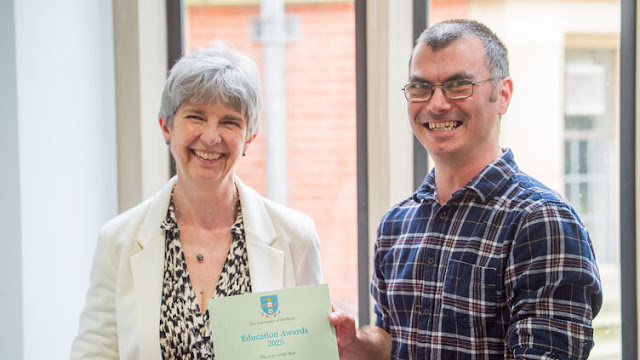
    In this blog, Marsya Ali profiles Dr Julian Dean, Senior Lecturer in Materials Science at the University of Sheffield and winner of the University’s Education Award for Teaching Practice in Engineering and Overall. The blog explores Julian’s approach to making engineering education engaging and accessible, from developing interactive virtual experiments through FlashyScience to using humour, creative examples and accessible language to help students understand complex concepts.

    When Dr Julian Dean was named winner of the University of Sheffield Education Award for Teaching Practice in Engineering and Overall, he described it as “really nice to be recognised.” But for Julian, a Senior Lecturer in Materials Science, the award wasn’t the goal. “I would have done [these things] without the award there,” he says. “It’s nice to know that it’s been seen as good practice.”

    Teaching Practice (Engineering) and Overall winner for teaching practice

    That practice includes everything from playing a guitar power chord to open lectures, to giving lectures with titles like The Phantom Error. But behind the humour is a clear pedagogical goal: to create experiences that engage students on their own terms, whether that’s through themed worksheets, accessible language, or interactive virtual labs.

    Julian’s standout contribution, FlashyScience, exemplifies this approach. Co-developed as a virtual lab platform that enables students to experiment at their own pace, Dr Joanna Bates described it as “revolutionising learning and solidifying understanding in engineering and science.” Combined with his outreach work, visual storytelling, and ever-evolving use of digital tools, it’s no surprise Julian’s approach resonates—not just with students, but with colleagues across the Faculty.

    FlashyScience: A lab beyond the classroom

    FlashyScience began as a school outreach project, driven by a simple question: how far could you stretch students beyond the curriculum? Co-founded with Professor Dan Allwood, the idea grew from a series of in-person STEM sessions into a spin-out company offering fully interactive virtual experiments.

    Screen shot of a virtual tensile tester experiment set up from the Flashy Science website
    The FlashyScience virtual ‘tensile test’ experiment

    At the heart of FlashyScience is accessibility. Giving learners the chance to experiment at their own pace, repeat processes without risk, and explore concepts far beyond GCSE level. From simulating tensile testing to observing radioactive decay across decades, students can interact with complex ideas in a safe, self-guided environment. It’s used by schools and universities alike, including in Sheffield’s undergraduate teaching.

    For some students, the platform has helped build confidence, especially those who might otherwise hesitate in physical lab spaces. “This has allowed a completely flat playing field,” Julian says. “Everyone can do it in their own time, at their own pace… and they get a bit more confidence about that.”

    Making Lectures Memorable

    Julian’s lectures are anything but ordinary. From The Phantom Error to festive worksheets on Santa stuck in a chimney, his sessions weave engineering concepts into familiar pop culture and playful scenarios. “It’s just really silly,” he says, “but the students seem to love it.”
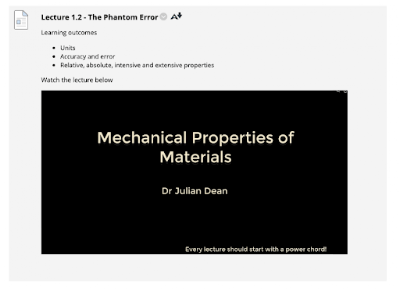
    presentation slide for mechanical properties of materials

    What started as a way to make sessions more engaging has become part of his teaching identity. During COVID, unsure how to begin recorded lectures, Julian decided to open each one with a guitar power chord—a choice that quickly became a student favourite.

    These elements aren’t just for show. They help students stay alert, connect with the content, and enjoy the learning process. “If you enjoy something, you’ll do it,” he explains—a principle that underpins his approach to making technical content memorable and accessible.

    Accessible Teaching: Simplified Language, Not Simplified Ideas

    Julian often uses simple analogies to make abstract concepts easier to grasp such as comparing atoms in a lattice to people holding hands: break the link, and the surrounding bonds might shift, redistribute, or even fall apart.

    This approach is especially useful for international students, who may be processing both scientific content and unfamiliar colloquialisms. By avoiding jargon, Julian ensures ideas remain accessible without being oversimplified, helping all students engage with confidence, regardless of background.

    Teaching That Thinks Like a Student

    Whether he’s building virtual labs or weaving pop culture into problem sets, Julian’s focus is always the same: thinking about how students learn best. “Not everyone learns in the same way,” he says. A reminder that accessibility and creativity aren’t add-ons, but core to effective teaching.

    That mindset is shaping what’s next. Starting this September and in partnership with the IOM3 and Discover Materials, first-year students in Materials Science will design their own outreach resources, from videos to podcasts, aimed at helping schoolteachers explain materials concepts. “They can pick five-year-olds if they really want a challenge,” Julian says. “Or 18-year-olds from college.”

    Students will choose everyday objects that interest them, from hockey sticks to climbing shoes, and link those to real-world materials science and school-level syllabuses. It’s part of a new collaboration with the Institute of Materials, Minerals & Mining (IOM3).

    It’s the same philosophy that runs through all of Julian’s work: teaching that meets students where they are, sparks curiosity, and gives them tools to go further.

    This is the first in a series of profiles of Engineering teaching staff at the University by Marsya Ali.

    When citing this work, please use the following citation:
    Ali, M (2025). “Teaching with a Twist: Star Wars, Science, and Student Confidence” Centre for Engineering Education Blog, The University of Sheffield, Sheffield, UK. July 2025.
    https://ceesheffield.co.uk/2026/10/29/teaching-with-a-twist-star-wars-science-and-student-confidence/

  • Reusable Teaching Blocks

    Reusable Teaching Blocks

    Colour square crayons

    Andrew Garrard from Multidisciplinary Engineering Education explores the idea of reusable teaching blocks: self-contained digital resources for teaching fundamental engineering concepts that can be shared across disciplines and courses. He considers how this approach could make teaching more efficient, support flipped learning and free up time for practical, problem-based activities. Andrew also outlines a proposed framework for developing these resources collaboratively and invites other engineering educators to help take the idea forward.

    This blog post is, in equal parts, personal musings, an idea and a call to arms. Reusable teaching blocks are an idea that could be very powerful?

    The department of Multidisciplinary Engineering Education is charged with a singular mission: to make the delivery of practical teaching efficient through scale. We identify the content and resources that can be shared by more than one engineering discipline and, when there is broad appeal, it justifies investing a significant amount of effort in developing a high quality, reusable resource.  Chemical, Aerospace and Civil engineers may apply their knowledge to different contexts, but they all require a fundamental understanding of, for example, fluid mechanics. Once we have developed a scalable fluid mechanics lab activity for one degree programme, it is really easy to offer it another with a few tweaks to account for a particular context.

    Because our activities are designed to be implemented using equipment in our laboratories, the extent to which they can be shared is limited by the geographical proximity of our students. Additionally, the equipment requires maintenance, space and physical infrastructure, all of which makes it difficult to replicate the teaching we deliver outside the University of Sheffield. But what if we could replicate the model of sharing teaching resources with the didactic teaching of theoretical engineering concepts rather than practical ones?

    We propose the idea of discrete, reusable teaching blocks, which are stand alone (or with a small amount of defined pre-requisite knowledge) digital, scalable objects that are used to deliver compartmentalised theoretical content. We feel that the time for this idea is now. After the covid-19 pandemic engineering educators have been kickstarted into developing lots of online resources, and gained experience, confidence and competence in doing so they may not have had before.  The sector has had an opportunity to test en-masse what works well and what doesn’t. And students have been forced to embrace new ways of being served content and have identified what aspects they find valuable and appropriate to be delivered in this way.

    The zeitgeist in engineering education is for learning through authentic or problem based approach. This is an excellent approach to engage students with real world applications and demonstrate the value of their knowledge, understanding and skills.  But it is important that we find mechanisms to actually teach the large amount of knowledge, understanding and skills that are required to engineer solutions to problems. Any tools used to make the teaching of engineering concepts more efficient, for both staff and students, allows more effort that can be expended on staff facilitating and students engaging with more open ended project type learning.

    Should all the teaching of didactic content be delivered online and with homogenous blocks of content? Of course not. Individual building blocks used in construction have no form in their own right. It takes the application of creativity and vision to assemble a collection of building blocks into a recognizable and coherent structure. And the same can be true for reusable teaching blocks. We can separate the functions of producing teaching material blocks and the function of selecting, arranging and contextualising them  If the job of producing the contents is done once, done well and used by many different courses, the intellectual effort of the educator, previously used to build the content, can be focused on the curation placed in the context of the disciple.

    The idea of reusable teaching blocks aligns perfectly with the method of flipped classrooms. When learning is flipped, didactic learning is delivered while staff are away from the students,allowing activities that are more valuable to be conducted during the face to face teaching.  Reusable teaching blocks could be used while the students are self-studying and the contact time is used to inspire and enrich the curriculum by articulating how the blocks relate to one another and using the content in the context of the specific disciple.

    CDIO is ostensibly a framework to codify teaching through problem based, design/build/test learning to allow quick deployment without the need to reinvent the wheel. Educators can dip into the framework and pull out the resources and teaching methodology to directly embed into their curricula. While problem based learning and design/build/test are engaging ways of demonstrating the application of engineering theory to real world problems, it can’t be used without students having basic engineering knowledge and understanding. I mean, it’s right there at the bottom of Bloom, indicating that you can’t do the application and analysis without the lower levels of the pyramid being first being there to rest on:

    What if a collaboration of like minded educators could get together to set up a framework with similar reach and value as CDIO, but for the reusable teaching blocks of didactic engineering concepts? Wouldn’t that be valuable for all engineering educators? We would be very interested in joining forces with anyone that could help make this idea come to life.

    The first step would be to define a framework. Here is my starter for ten:

    In the metaphor, the type of blocks we are imagining about are more like wooden building blocks than lego (other variously coloured interlocking plastic bricks are available).  Lego blocks have a pre-defined orientation and limited ways in which they can interconnect. Reusable teaching blocks should be more like wood teaching blocks that can be oriented and arranged to build any conceivable structure. The concepts are the blocks, the educator is the architect designing the structure and the disciple context is the glue that holds the blocks together in the chosen form. To allow facilitate this, reusable blocks should ensure:

    • They are stand alone or with as little prerequisite knowledge as possible.
    • Where prerequisite knowledge is unavoidable, blocks should be clearly signposted (preferably to other reusable teaching blocks). However complex learning environments can be created by stacking a number of blocks into ‘Elements’. These can be reused in part or whole as needed.
    • They are atomistics: blocks should aim to introduce as few concepts as possible
    • Specific applications or examples of concepts should be separated from the description of the concept. Context and examples can be created as additional blocks to form part of the menu.
    • Terminology or nomenclature should be fully explained to ensure it is stand alone.
    • They are free of decorative clutter, subject or context information or corporate branding.
    • They may have associated micro assessments to ensure engagement.

    When citing this work, please use the following citation:
    Garrard, A (2021). “
    Reusable Teaching Blocks” Centre for Engineering Education Blog, The University of Sheffield, Sheffield, UK. September 2021. https://ceesheffield.co.uk/2026/10/29/reusable-teaching-blocks/