Tag: Professional Development

  • From Red Line Week to Engineering Education Scholarship Week: Why Taking Time Out Matters

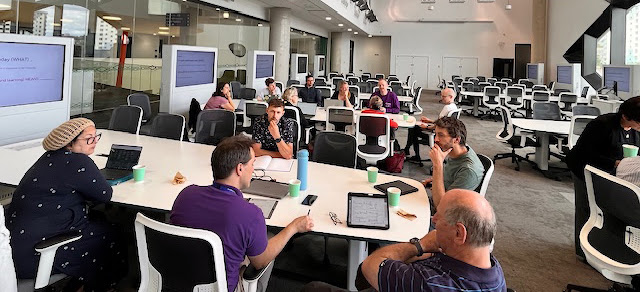
    University of Sheffield staff attending a Engineering Education session

    The Centre for Engineering Education is an initiative to support the educational aims of Engineering at The University of Sheffield, and open to all, and especially the many and varied people who support these aims. In this post Emma Kenny-Levick, a Senior Administration Officer at The University of Sheffield and super power behind the CEE blog, shares how scholarship led her to challenge her assumptions, and to make time for reflection that changed on her own practice.

    When I first joined Multidisciplinary Engineering Education (MEE), a recurring block of events appeared in my calendar titled “Red Line Week.” I didn’t really know what it meant. I knew it was something to do with scholarship and personal development, two terms that, at the time, felt distant from my day‑to‑day role. I was new, busy and focused on learning the practical realities of my job. Taking time out to think about scholarship didn’t feel relevant.

    I was a professional services member of staff so why was scholarship relevant to me?

    So, like many others across the Faculty of Engineering might have done, I ignored it. I didn’t read the emails. I didn’t consider attending the sessions. Not even when hot refreshments, pastries and lunch were offered.

    If only I’d known then what I understand now.

    With hindsight, I can see clearly what Red Line Week was always intended to be and why it has become such a valuable part of our engineering education community today, now known as Engineering Education Scholarship Week (EESW).

    Drawing a line through the working week

    Red Line Week was developed and championed by Dr Matteo Di Benedetti, Senior University Teacher in MEE and Co‑Director of the Centre for Engineering Education (CEE). The idea was simple: draw a red line through your work calendar and use that protected time to focus on your own development.

    At the time, I associated development with formal training courses or mandatory requirements, not with taking space to think, reflect, write or talk with others about how I did my job and how I could do it better.

    And I certainly didn’t see how scholarship related to me.

    “What is scholarship and what has it got to do with my role?”

    For me, scholarship felt abstract. It sounded academic, theoretical, something for university teachers, not for someone in professional services.

    It wasn’t until my third year in MEE that something shifted. I looked more closely at the programme and spotted a session on effective evaluation, something directly relevant to my work. I decided to attend.

    That was the moment the penny dropped.

    I realised that scholarship wasn’t about doing something extra or becoming someone different. It was about developing ideas to improve practice. About taking what you do every day and looking at it more critically with the aim of making it better. Scholarship wasn’t separate from my role, it strengthened it.

    Space to think, not just sessions to attend

    What I came to understand is that EESW isn’t just about workshops or keynotes, though those matter. It’s about creating space.

    Space to sit in a room with like‑minded people.
    Space to reflect on what works (and what doesn’t).
    Space to talk openly about teaching, learning, evaluation, identity and confidence.

    Over time, the programme has grown from strength to strength. What began as Red Line Week has evolved into a rich programme that now includes:

    ●      Keynotes and workshops on engineering education, scholarship, academic identity, writing and open practices

    ●      Engineering and Teaching Shorts (EATS)

    ● Education Themed Networks (ETNs) bringing colleagues together around shared interests

    ●      Dedicated scholarship spaces for focused thinking, discussion and writing

    ●      Sessions delivered in partnership with colleagues from across the University, including Elevate and Student Support
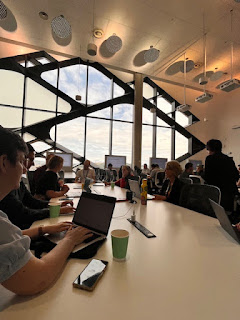
    University of Sheffield staff attending a Engineering Education session

    Crucially, EESW welcomes academics, researchers, GTAs, professional services and technical colleagues. It recognises that improving engineering education and the student experience, is a shared endeavour.

    Seeing the value of time taken out

    Now, when I see EESW in my calendar, I see it very differently.

    I see the benefit of stepping away from routine tasks to think about what I do and how I might do it better. I see how confidence grows when people realise that their experiences and ideas matter. And I see how investing time in staff development feeds directly into stronger teaching, better support services and richer learning for students.

    I also see something else: permission.

    Permission to slow down.
    Permission to reflect.
    Permission to invest in yourself without feeling that you should be doing something else.

    In a sector that often feels pressured and reactive, having structured, protected time like this is not something to take for granted.

    Why I wish more people would give it a try

    If you’ve ever looked at EESW (or Red Line Week, as it once was) and thought, ‘this isn’t for me’, I understand that reaction as I had it too.

    But my experience has taught me that taking time out for personal and professional development isn’t a luxury, it’s a necessity. It sustains good practice and strengthens not only how we work but how we work together.

    Engineering Education Scholarship Week is, at its heart, about people: their ideas, their growth and the space to develop both.

    If you’re curious about what that looks like in practice, here are a couple of highlight videos from past programmes:

    ●      Why Engineering Education Scholarship week and the benefits of attending

    ●      EESW July 2025 Highlights Video

    ●      EESW January 2026 Highlights Video

    And if you’re on the fence next time it appears in your calendar, my advice is simple: draw the red line and see what happens.

    When citing this work, please use the following citation:
    Kenny-Levick, E (2026). “From Red Line Week to Engineering Education Scholarship Week: Why Taking Time Out Matters” Centre for Engineering Education Blog, The University of Sheffield, Sheffield, UK. May 2026. https://ceesheffield.co.uk/2026/10/27/redlineweek/
  • Engineering and Teaching Shorts: Keeping CPD Bite-Sized and Impactful

    Michael Trikić explores how Engineering and Teaching Shorts (EATS) provides informal, accessible professional development for academic and professional services staff at the University of Sheffield. Established to encourage the sharing of teaching ideas and practical experience, the programme covers topics ranging from inclusive teaching and student wellbeing to digital skills and generative AI. The blog looks at how EATS responds to staff interests, works with the Centre for Engineering Education (CEE), and supports small changes in teaching practice through discussion, collaboration and shared learning.

    In Higher Education time is always in short supply, so finding space for meaningful professional development can be a challenge. That’s where Engineering and Teaching Shorts (EATS) comes in: a bite-sized, informal Continuing Professional Development (CPD) series that makes space for reflection, inspiration, and conversation, all over a buffet lunch.

    Led by Michael Wright, Faculty Education Advisor for Engineering, EATS offers a practical and engaging route into continuous learning for both academic and professional services staff. “It’s very much not a one-size-fits-all message,” Michael explains. “You’re not being told to do X or Y.” Instead, sessions are built around shared stories and practical examples designed to spark new ideas in day-to-day teaching.

    What is EATS? A format that sticks

    EATS is a CPD initiative established in the early 2010s by Professor Stephen Beck, here at the University of Sheffield. It was created to encourage peer-led development through practical sessions that highlight different approaches to teaching and learning, and since inception over 200 have been held.

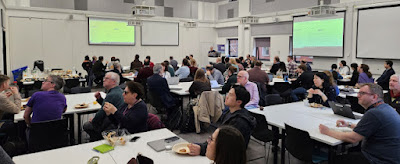
    University of Sheffield staff attending an EATS session

    Sessions are shaped around key themes in engineering education, from inclusive design and mental health support to generative AI and feedback strategies, and led by a mix of internal and external speakers.

    What sets EATS apart is its format. The programme is intentionally flexible, welcoming, and non-prescriptive, a structure that encourages ideas to circulate without pressure. “It’s informal,” Michael says. “You can engage as much as you like. You can sit at the front and ask questions… or just quietly absorb what’s going on.”

    How Topics Are Chosen: A Finger on the Pulse

    While some themes, such as mental health, international student support, or library updates, are recurring staples in EATS, the wider calendar is shaped by what’s current, timely, and useful to staff. Michael draws inspiration from university education conferences, listening for topics that spark discussion across faculties, and often invites speakers to adapt and re-share presentations for the engineering context.

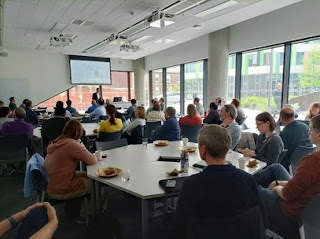
    University of Sheffield staff attending an EATS session

    This responsive model ensures that EATS stays relevant. Some sessions are prompted by sector-wide developments, like the introduction of Blackboard Ultra or the growing interest in generative AI.

    Others respond to quieter but meaningful shifts. For instance, after noticing staff concerns about students’ digital readiness, Michael invited colleagues from the 301 Academic Skills Centre to showcase training resources in tools like Excel, helping staff to meet students’ digital training needs.

    Ideas also emerge from informal channels. Conversations with colleagues and staff simply asking, “Could we have a session on this?”. That mix of structured insight and on-the-ground curiosity allows EATS to remain grounded in real teaching needs while reflecting broader trends in higher education. If you have any ideas for sessions, get in contact with Michael.

    Collaboration with CEE

    The collaboration between EATS and the Centre for Engineering Education (CEE) allows ideas from conferences and faculty projects to circulate more widely, with EATS sessions used both for sharing insights and testing new material.

    EATS sessions are also used to support both preparation for and reflection on conference participation. Staff who receive CEE funding to attend events are often invited to share their insights afterwards. For example, Professor Emma Norling shared her reflections from the Innovation and Technology in Computer Science Education (ITiCSE) conference with colleagues while Dr Michael Trikić used his inclusive engineering session to gather examples and refine his talk ahead of presenting at the SEFI conference.

    The initiative has also offered space for experimentation. A recent hybrid session on generative AI brought together staff from The University of Sheffield and University College Dublin, with both groups gathered in their respective locations and linked via video call—the first of its kind for EATS. “That was a really nice way to broaden the remit and deliver something engaging,” Michael said.

    The Impact: Small Bites, Big Shifts

    EATS sessions have prompted meaningful changes in teaching practice, from day-to-day adjustments to broader shifts in mindset. Staff shared their approaches to effective assessment in a well-attended EATS session, Assessment and Feedback at Scale. The following year, student feedback on that area improved in the NSS—a change Michael sees as “one of the contributing factors that maybe helped.”

    Sessions on cultural awareness and name pronunciation have also had a practical impact, especially in preparation for student-facing events like graduation. Staff have reported feeling more confident supporting international students and recognising the value of small details, such as learning how to pronounce Chinese names correctly.

    Others have taken away tools they can apply immediately. After attending a generative AI session, one staff member began using Google Gemini to assist with writing tasks, a tool Michael himself has adopted in his work. Sessions on student wellbeing have also helped staff feel better equipped to signpost mental health support and recognise when to seek help on a student’s behalf.

    Through these small but cumulative changes, EATS continues to shape a more responsive, inclusive, and thoughtful teaching environment. One practical session at a time.

    Citation:
    Trikic, M. (2025). “Engineering and Teaching Shorts: Keeping CPD Bite-Sized and Impactful” Centre for Engineering Education Blog, The University of Sheffield, Sheffield, UK. November 2025. https://ceesheffield.co.uk/2026/10/29/engineering-and-teaching-shorts-keeping-cpd-bite-sized-and-impactful/