Tag: simulation

  • Becoming Comfortable with Black Box Engineering

    In this article, Professor Andrew Garrard from the University of Sheffield and Dr Parakram Pyakurel from New Model Institute for Technology and Engineering discuss whether engineering education’s traditional resistance to “black box” thinking remains fit for purpose. As simulation software, Industry 4.0 methods, and generative AI make it harder for engineers to understand the tools they use, is it time to take a pragmatic approach in education and consider black box engineering not as a threat to be resisted, but as an inevitability to be acknowledged?
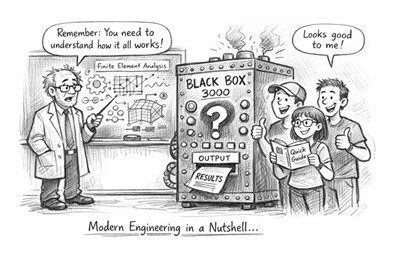
    cartoon of modern engineering in a nutshell

    Cartoon images generated by AI using the prompt “Please can you read this article and come up with a simple pencil drawing cartoon that makes light of the general themes of the piece?”. This image was created using Open AI’s ChatGPT 5.4.

    There is a widely held belief amongst engineering educators that students should be discouraged from relying on a “black box” approach to engineering; that is, producing results using methods and tools with little or no understanding of how they work. Moreover, it can be considered dangerous to certify a graduate as competent if they accept, on faith, the validity of results generated by means they do not understand.

    To what extent, however, is this view an anachronism, tightly clung to by academia but no longer reflective of real-world engineering practice?
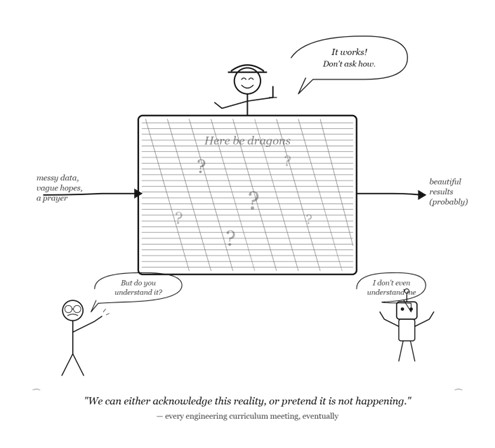
    Cartoon images generated by AI using the prompt “Please can you read this article and come up with a simple pencil drawing cartoon that makes light of the general themes of the piece?”. This image was created using Anthropic’s Opus 4.6.

    Consider, for example, predicting how a system will behave through engineering simulation, such as by using the finite element method. In previous generations, it was conceivable that engineers could build, from the ground up, the software required to perform finite element calculations. This was possible because the limits of computational power meant that only relatively simple systems could be analysed using comparatively straightforward numerical techniques.

    Fast forward to today, and modern engineering simulation software can consist of hundreds of gigabytes of code and mind-bogglingly complex algorithms designed to optimise every stage of the process. Take the generation of computational meshes. In the past, engineers constructed meshes manually, deciding the position of nodes and connecting them together with lines. Today, powerful automated meshing algorithms generate highly complex meshes as part of a largely turnkey process.

    It is unrealistic to expect engineering students, who are learning multiple topics across a wide range of domains, to understand the detailed inner workings of every piece of software they use. As the ability to understand precisely what engineering simulation software is doing has diminished, it has been replaced by an increased emphasis on heuristics: I chose this turbulence model because experience suggests it performs well for this type of fluid flow.
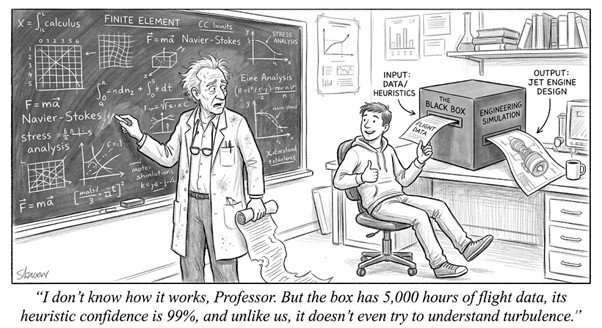
    Cartoon depicting black box engineering

    Cartoon images generated by AI using the prompt “Please can you read this article and come up with a simple pencil drawing cartoon that makes light of the general themes of the piece?”. This image was created using Google’s Gemini 3.1

    The same “black box” approach underpins many aspects of Industry 4.0, and more recently Industry 5.0. Rather than fully understanding the physical mechanisms governing the dynamics of engineering systems, sufficiently large datasets can be used to predict outcomes accurately through sophisticated statistical methods.

    The world is already full of black-box engineering, and this trend is only likely to accelerate with the rapid advancement of artificial intelligence. While it may be extremely challenging to fully understand all the methods used in modern, complex engineering software, the algorithms involved are at least deterministic. By contrast, the stochastic outputs of Generative AI, like large language models, means that determining how they will respond to any given input is not something anyone can reliably predict, even those who have built the models. As AI becomes increasingly embedded within software products, additional opaque layers will accumulate, making it ever more difficult to truly understand what the computer is doing.

    Whether the adoption of a “black box” approach to engineering is desirable remains open to debate. What seems less debatable, however, is its inevitability in the modern world. We can either acknowledge this reality, or pretend it is not happening.

    Once we admit this – what are the implications?

    The increasing complexity of computational methods, together with the advent of AI systems whose behaviour can be difficult to fully understand, may appear to be a distinctly modern problem. However, making predictions about how systems will behave with limited understanding of the underlying governing principles has long been the standard approach of empiricists.

    Often attributed to Heisenberg is the quote:

    “When I meet God, I am going to ask him two questions: Why relativity? And why turbulence? I really believe he will have an answer for the first.”

    As a species, we remain unable to analytically calculate turbulent flow. Yet engineers are able to model aeroplanes, pipelines, and wind turbines with impressively high precision. While imparting conceptual understanding of fundamental engineering principles is important, we may be overlooking opportunities to train students in data analysis, interpretation, and subsequent processing.

    As educators, our task is to equip students with the understanding and tools necessary to have a positive impact on the world. In already crowded engineering curricula, content must compete for inclusion among the many topics considered essential for an undergraduate programme. If complexity, big data, and stochastic computation are becoming commonplace, is there a need to shift some emphasis away from traditional physical sciences toward statistics, empiricism, and validation?

    When citing this work, please use the following citation:
    Garrard, A & Pyakurel, P. (2026). “Becoming comfortable with black box engineering”. Centre for Engineering Education Blog, The University of Sheffield, Sheffield, UK. March 2026. https://ceesheffield.co.uk/2026/10/27/blackboxengineering/
  • Teaching with a Twist: Star Wars, Science, and Student Confidence

    Teaching with a Twist: Star Wars, Science, and Student Confidence

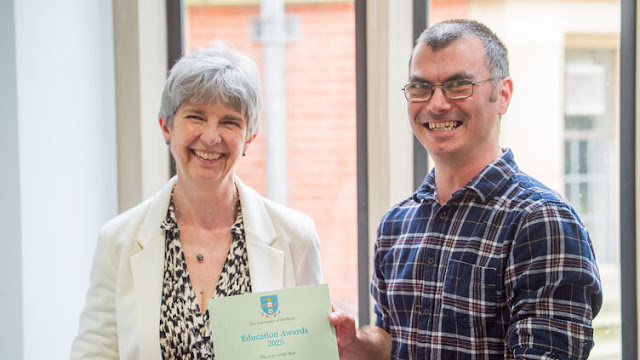
    In this blog, Marsya Ali profiles Dr Julian Dean, Senior Lecturer in Materials Science at the University of Sheffield and winner of the University’s Education Award for Teaching Practice in Engineering and Overall. The blog explores Julian’s approach to making engineering education engaging and accessible, from developing interactive virtual experiments through FlashyScience to using humour, creative examples and accessible language to help students understand complex concepts.

    When Dr Julian Dean was named winner of the University of Sheffield Education Award for Teaching Practice in Engineering and Overall, he described it as “really nice to be recognised.” But for Julian, a Senior Lecturer in Materials Science, the award wasn’t the goal. “I would have done [these things] without the award there,” he says. “It’s nice to know that it’s been seen as good practice.”

    Teaching Practice (Engineering) and Overall winner for teaching practice

    That practice includes everything from playing a guitar power chord to open lectures, to giving lectures with titles like The Phantom Error. But behind the humour is a clear pedagogical goal: to create experiences that engage students on their own terms, whether that’s through themed worksheets, accessible language, or interactive virtual labs.

    Julian’s standout contribution, FlashyScience, exemplifies this approach. Co-developed as a virtual lab platform that enables students to experiment at their own pace, Dr Joanna Bates described it as “revolutionising learning and solidifying understanding in engineering and science.” Combined with his outreach work, visual storytelling, and ever-evolving use of digital tools, it’s no surprise Julian’s approach resonates—not just with students, but with colleagues across the Faculty.

    FlashyScience: A lab beyond the classroom

    FlashyScience began as a school outreach project, driven by a simple question: how far could you stretch students beyond the curriculum? Co-founded with Professor Dan Allwood, the idea grew from a series of in-person STEM sessions into a spin-out company offering fully interactive virtual experiments.

    Screen shot of a virtual tensile tester experiment set up from the Flashy Science website
    The FlashyScience virtual ‘tensile test’ experiment

    At the heart of FlashyScience is accessibility. Giving learners the chance to experiment at their own pace, repeat processes without risk, and explore concepts far beyond GCSE level. From simulating tensile testing to observing radioactive decay across decades, students can interact with complex ideas in a safe, self-guided environment. It’s used by schools and universities alike, including in Sheffield’s undergraduate teaching.

    For some students, the platform has helped build confidence, especially those who might otherwise hesitate in physical lab spaces. “This has allowed a completely flat playing field,” Julian says. “Everyone can do it in their own time, at their own pace… and they get a bit more confidence about that.”

    Making Lectures Memorable

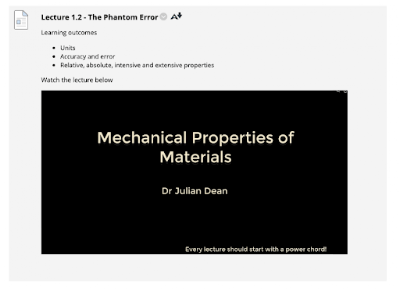
    Julian’s lectures are anything but ordinary. From The Phantom Error to festive worksheets on Santa stuck in a chimney, his sessions weave engineering concepts into familiar pop culture and playful scenarios. “It’s just really silly,” he says, “but the students seem to love it.”

    presentation slide for mechanical properties of materials

    What started as a way to make sessions more engaging has become part of his teaching identity. During COVID, unsure how to begin recorded lectures, Julian decided to open each one with a guitar power chord—a choice that quickly became a student favourite.

    These elements aren’t just for show. They help students stay alert, connect with the content, and enjoy the learning process. “If you enjoy something, you’ll do it,” he explains—a principle that underpins his approach to making technical content memorable and accessible.

    Accessible Teaching: Simplified Language, Not Simplified Ideas

    Julian often uses simple analogies to make abstract concepts easier to grasp such as comparing atoms in a lattice to people holding hands: break the link, and the surrounding bonds might shift, redistribute, or even fall apart.

    This approach is especially useful for international students, who may be processing both scientific content and unfamiliar colloquialisms. By avoiding jargon, Julian ensures ideas remain accessible without being oversimplified, helping all students engage with confidence, regardless of background.

    Teaching That Thinks Like a Student

    Whether he’s building virtual labs or weaving pop culture into problem sets, Julian’s focus is always the same: thinking about how students learn best. “Not everyone learns in the same way,” he says. A reminder that accessibility and creativity aren’t add-ons, but core to effective teaching.

    That mindset is shaping what’s next. Starting this September and in partnership with the IOM3 and Discover Materials, first-year students in Materials Science will design their own outreach resources, from videos to podcasts, aimed at helping schoolteachers explain materials concepts. “They can pick five-year-olds if they really want a challenge,” Julian says. “Or 18-year-olds from college.”

    Students will choose everyday objects that interest them, from hockey sticks to climbing shoes, and link those to real-world materials science and school-level syllabuses. It’s part of a new collaboration with the Institute of Materials, Minerals & Mining (IOM3).

    It’s the same philosophy that runs through all of Julian’s work: teaching that meets students where they are, sparks curiosity, and gives them tools to go further.

    This is the first in a series of profiles of Engineering teaching staff at the University by Marsya Ali.

    When citing this work, please use the following citation:
    Ali, M (2025). “Teaching with a Twist: Star Wars, Science, and Student Confidence” Centre for Engineering Education Blog, The University of Sheffield, Sheffield, UK. July 2025.
    https://ceesheffield.co.uk/2026/10/29/teaching-with-a-twist-star-wars-science-and-student-confidence/