Tag: Student Experience

  • Finding the Right Engineering Path

    In this personal blog, undergraduate student Maddy McGuire reflects on how an uncertain start, brought on by Covid and virtual course searches, led to discovering the perfect course – Bioengineering (now called Biomedical Engineering) here at The University of Sheffield. Maddy shares how her course, team projects and a transformational placement at Mercedes AMG have shaped her technical skills, confidence and career aspirations.

    When I was looking for courses during my A-level years, Covid stopped me from attending open days, with only virtual tours available. I had limited information about Bioengineering at the University of Sheffield, but had always loved maths and chemistry and wanted to find a way to apply those subjects to the real world. I found out the course offered me a way to change the future of healthcare without having to undertake a medical degree or an intense amount of biology. Through the course, I quickly realised that my passion was in healthcare technology, rather than the biological functions themselves.
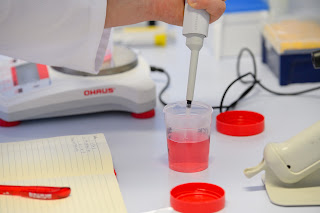
    Experiment in a bio bacterial lab

    With Bioengineering being an interdisciplinary course, there were many different routes and modules available throughout the years. I have studied Biomedical engineering, but also automated control systems, mechanical engineering, electrical engineering, materials science and even business. This breadth of course choice has allowed me not only to explore possible routes, but also refine and specialise in those that I found the most interesting. I have thoroughly enjoyed group projects, where I worked with different engineers with distinct expertise. Although challenging at time, submitting a completed project as a team was an incredible and rewarding, and helped me improve my interpersonal skills.

    With Bioengineering being an interdisciplinary course, there were many different routes and modules available throughout the years. I have studied Biomedical engineering, but also automated control systems, mechanical engineering, electrical engineering, materials science and even business. This breadth of course choice has allowed me not only to explore possible routes, but also refine and specialise in those that I found the most interesting. I have thoroughly enjoyed group projects, where I worked with different engineers with distinct expertise. Although challenging at time, submitting a completed project as a team was an incredible and rewarding, and helped me improve my interpersonal skills.

    A Year in Industry

    As an additional part of my course, I undertook a year in industry at Mercedes AMG High Performance Powertrains, that was both enriching and personally formative. I oversaw the creation, build and testing of plans, presented them to colleagues and managed resource allocations to ensure that all hardware was distributed correctly. If changes were required, I coordinated with many different departments, including manufacturing to schedule these modifications and ensure completion under strict time pressure. I compiled shortage reports and burndown charts which help to track parts against their due dates. During build days, I would have to communicate between the building and engineering teams, release Build Requests and ensure that each team was on hand to support whenever needed. My role was pivotal in finding causes of unit failure and resolving these issues.
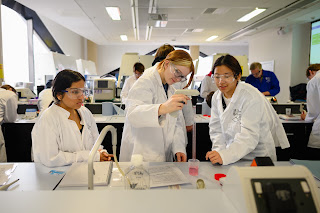
    Students working in a bio tissue lab

    My placement gave me professional and technical skills. I learned to communicate for effectively, and by coordinating teams have developed my confidence, time management and leadership skills. I gained experience of industry relevant software including Excel, SAP and PowerBI. However, the most important skill I developed was my organisational skills, with constant shifting priorities and a fast-paced environment, I often had to adjust my plans last minute to achieve the goal within the deadline.

    My placement gave me professional and technical skills. I learned to communicate for effectively, and by coordinating teams have developed my confidence, time management and leadership skills. I gained experience of industry relevant software including  Excel, SAP and PowerBI. However, the most important skill I developed was my organisational skills, with constant shifting priorities and a fast-paced environment, I often had to adjust my plans last minute to achieve the goal within the deadline.

    When preparing to undertake this placement, I focussed on taking business modules throughout my course. These courses gave me insight into what to expect as part of a company as large as Mercedes and the technical skills to be able to execute my role in the operation with success.

    Life as a Biomedical Engineering Student

    With a limited number of Bioengineering courses available across the UK, I was pleased to find that Sheffield offered one. With the top-rated student union in the UK, Sheffield appealed to me as a social and lively university – and I have not been disappointed. Furthermore, having virtually toured Endcliffe and Ranmoor accommodation, they appealed strongly to me as a place to live as I started my degree. With the correct course, vibrant social life and top-notch accommodation, Sheffield was the perfect place for me to Study Bioengineering.
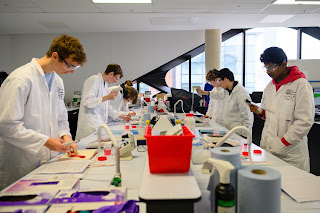
    Student working in a bio bacterial lab

    For me, the most enjoyable aspect of Sheffield university has been the social aspect, and the variety of ways to engage with other members of the community. From my course to sports and societies, I have been introduced to such a wide variety of people, many of which have become my closest friends. Many of my friends have graduated, but they are lifelong friends, and we still maintain contact and see each other whenever we can. A particular highlight of the social and sporting calendar was watching the varsity Ice Hockey match, which quickly became a tradition as a reliably fun event.

    Now looking forward, I will be applying to programme management and logistics roles in different industries, including healthcare. This will allow me to understand how different roles function within different sectors and see the differences in their supply chain management. All of this will give me the insight I need to decide which sector or industry I will want to specialise in and start my career progression with that sector in mind.

    When citing this work, please use the following citation:

    McGuire, M. (2026). “Find the right engineering path”. Centre for Engineering Education Blog, The University of Sheffield, Sheffield, UK. November 2025. https://ceesheffield.co.uk/2026/10/27/findingtherightengineeringpath/
  • Innovation in Engineering Education – The Diamond – Twelve Architects

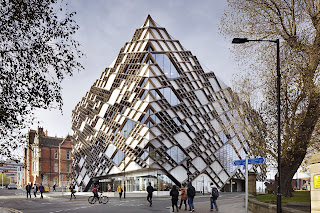
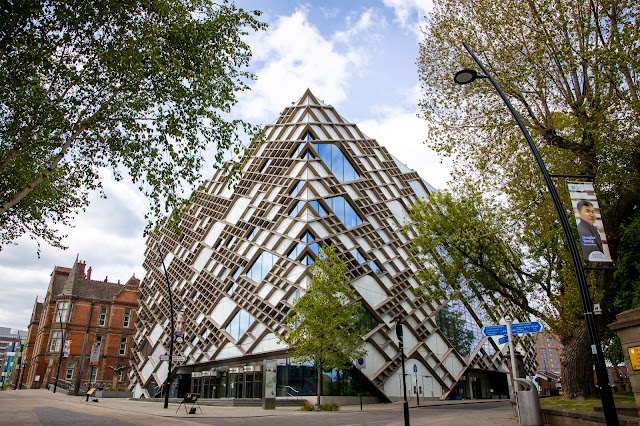
    Exterior of the diamond building

    The conception of the Diamond Building was a huge project here at Sheffield Engineering that aimed to make a world leading space for Engineering teaching. It is the home of  high quality teaching labs for all the engineering disciplines, as well as innovative teaching and study space. It is a wonderful space to be in and remains as popular as ever with students. The building led to the creation of a specialist multidisciplinary team to deliver and coordinate the teaching that takes place in it, and they continue to lead innovation in teaching and learning and are core contributors to the Centre for Engineering Education. This wouldn’t have been possible without the team who built the Diamond, Twelve Architects. They made the space both iconic and great for teaching, something that is often overlooked, but that has a huge impact on learning and learners. In this post Twelve Architects share their perspective of the project.

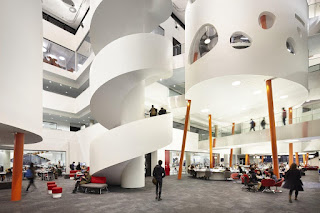
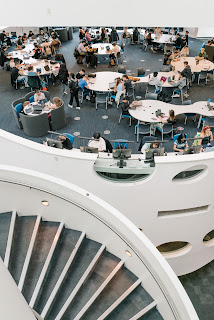
    study space in the diamond building

    September 2025 marked ten years since the opening of The Diamond at the University of Sheffield, a landmark project that continues to inspire over a decade on. As our first completed UK building, The Diamond was a defining moment for Twelve Architects, setting the tone for our approach to design, collaboration and innovation.

    Reflecting on this milestone, we asked members of the original design team, Matt Cartwright and Lorraine Stoutt Griffith, to share their experiences of working on the building that helped to shape our future as a practice.

    Designed to transform the way engineering was taught at the University, The Diamond brings together multiple disciplines under one roof, creating a flexible, future-focused environment that encourages interaction, learning and discovery. Ten years later, the building remains one of the UK’s most advanced teaching and research facilities, and one we’re immensely proud to have worked on.

    “The atrium remains one of the building’s most uplifting surprises,” recalls Lorraine. “It’s open, light and full of character, with a variety of places to spend time or work. We painted the steel structure orange to reveal how the building works. It’s a detail that makes it particularly special for the structural engineers who use it.”

    Behind the building’s confidence lies the complexity of its delivery. From the organically shaped windows to the curved pod walls, every detail required careful coordination. “It wasn’t without its challenges,” says Lorraine, “but the ambition and commitment across the team made it possible. Seeing it now, still thriving and crowded with students, makes it all worthwhile. It set a great standard for the student experience.”

    For Matt, the project carries a deep personal significance. “The vision was to create a landmark building that would attract students and staff, and support the University in becoming one of the leading engineering faculties in the UK and internationally,” he reflects. “The project was founded on trust, hard work and a collective desire to succeed. When challenges arose, we found solutions together, a rarity that shaped my belief in the power of collaboration.”

    Years later, The Diamond remains one of the UK’s most advanced and well-used engineering facilities, a space that is both functional and inspiring. Matt adds. “My parents met as students at the University of Sheffield. To have designed a building that continues to inspire future generations is priceless.”

    spiral staircase in the diamond building

    Looking back, both Lorraine and Matt agree that The Diamond exemplifies the values that continue to guide Twelve’s work today: trust, ambition, quality and collective strength.

    “Be ambitious,” says Lorraine. “Bring the team with you, client, users, engineers, contractors, and maintain the quality of materials. It was a struggle to keep the cladding anodised, but seeing it now, it was absolutely the right decision.”

    “Trust, ambition and a clear vision,” echoes Matt, “are the lessons that we have carried through to every project since.”

    The Diamond continues to stand as a testament to design excellence, innovation and collaboration, and as a project that will always hold a special place in our hearts.

    When citing this work, please use the following citation:

    Hearne, B. (2025). “Ten Years of The Diamond – Twelve Architects”. Centre for Engineering Education Blog, The University of Sheffield, Sheffield, UK. January 2026. https://ceesheffield.co.uk/2026/10/27/innovationinengineeringeducation/

  • Celebrating over a Decade of Impact at The Diamond

    In this reflective piece, Sophie Barwick takes us through the special 10-year celebration of the Diamond building —now firmly established as the heart of engineering education at the University of Sheffield. From cutting-edge labs and inspiring staff, to the student-driven innovation of the iForge, Sophie shares how the Diamond has shaped her journey as both a student and GTA. Her insight captures the building’s enduring purpose: a space built for students, enriched by community, collaboration, and hands-on learning.

    Exterior of the diamond building

    Back in October 2025, the Diamond opened its doors to staff, students, alumni and visitors to celebrate 10 years of the Diamond building. Over this time the Diamond building has become a fundamental place for the education of thousands of engineering students at the University of Sheffield. The range of state of the facilities, enthusiastic staff and open study spaces make it a great place to learn and develop skills.

    The Diamond building offers a range of laboratories and lecture theatres to teach students engineering concepts from across all disciplines under one roof, marking it as the flagship teaching facility for the faculty. It therefore also enables students to have a base to explore new concepts and work together, particular crucial for those new to university and Sheffield.

    In addition to timetabled teaching, key part of the student experience in the diamond is the iForge – the UK’s first student-led makerspace. This facility allows both engineering and students from across the university to make their ideas reality while learning practical skills and, for those selected as iForge representatives, an opportunity to develop their teaching and leadership skills as well.

    Staff from a range of academic and industrial backgrounds form a team of teaching and support staff within the department of Multidisciplinary Engineering Education which is supportive, encouraging and enthusiastic about engineering education. The staff, primarily based in laboratories, teach students from a range of engineering disciplines and levels of study with the support and guidance relevant for their background. They also work throughout the year adapting lab activities to ensure they align with module content and current technologies.

    The Faculty of Engineering are able to offer and teach the activities to so many students in the diamond thanks to the assistance of graduate teaching assistants (GTAs). Often graduates from undergraduate courses at the University of Sheffield themselves, GTAs are current PhD students with expertise to help and guide students in each of the laboratories, increasing the staff to student ratio, and therefore better supporting the students.

    I was honoured to be invited as a guest on the “Student Experience” panel for the Decade of the Diamond celebration event. The Diamond building, and the facilities within it, have been fundamental to my development during my time at the University of Sheffield and it was great to be able to offer insight into my experience in as both a student and GTA in the Faculty of Engineering, University of Sheffield.

    It’s fantastic to see the student voice continue to be so actively involved in the continued evolution of the Diamond. After all, as Professor Stephen Beck said “the Diamond is and always was a building designed for the students”.

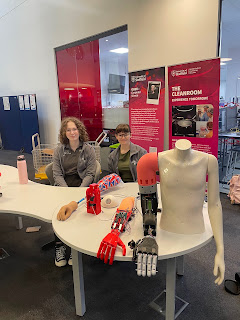
    Robotic arm on an exhibition stand

    In addition to the student voice session, the celebration event heard from many speakers key to the development of the Diamond building and the teaching within it, including the original architects from Twelve Architects,

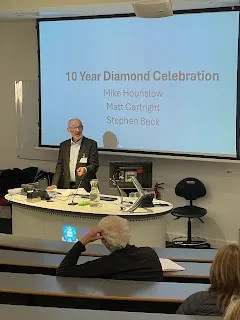
    Mike Hounslow delivering an opening address

    Professor Stephen Beck, the founding Head of Multidisciplinary Engineering Education, and Professor Emeritus Mike Hounslow, Pro Vice-Chancellor for Engineering during the construction. They reflected on the development of the Diamond from its original conception to how to it is still developing today.

    Sir John Lazar CBE FREng, president of the Royal Academy of Engineering, and representatives from across industry offered insight into how the Diamond building develops well-rounded engineering graduates, equipped with the skills they need for their future careers.

    Sir John Lazar CBE FREng, president of the Royal Academy of Engineering, and representatives from across industry offered insight into how the Diamond building develops well-rounded engineering graduates, equipped with the skills they need for their future careers.

    Throughout the day, in the Moonscape study area, there was stalls displaying the fantastic work of both the diamond laboratories and each of the schools in the faculty of engineering. There were also talks from many of the schools reflecting on the opportunities they offer students, with particular focus on inclusivity and accessible research and learning tools.

    The day also allowed for many opportunities to network with members of current and previous staff who have helped shape MEE, as well as those crucial in the realisation of the Diamond building itself.

    Many thanks to Harry Day, Emma Kenny-Levick, Andrew Garrard, and all involved in organising the event – I look forward to the next one!

    When citing this work, please use the following citation:

    Barwick, S. (2025). “Celebrating a Decade of Impact at The Diamond”. Centre for Engineering Education Blog, The University of Sheffield, Sheffield, UK. January 2026. https://ceesheffield.co.uk/2026/10/27/celebratingimpact/

  • Scaling Up Practical Engineering Labs for Teaching Spaces

    Thermodynamic lab in the diamond building

    Efficiency in engineering education is important for managing large cohorts and can be successful as long as the key metric is quality. Dave Brown, Rob Woolley and Andrew Garrard demonstrated how to do it, by scaling up and delivering a fundamental thermodynamics practical class for a large, non-specialist teaching space, with larger cohorts and with fewer sessions. Here, they share the secret to reducing staff time, improving flexibility, and creating a lively learning environment, with good student experience at the core.

    At Sheffield, we use innovative approaches to deliver practical teaching, such as workshop and laboratory classes, at scale. We aim to provide as much hands-on learning as possible. There are, however, limits to what we can offer. These limits may arise from timetable constraints, staff availability, or the amount of laboratory space.

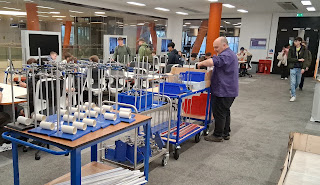
    One way to overcome constraints on laboratory space, make the best use of staff time, and simplify student timetables is to teach fewer lab sessions to larger cohorts in suitable teaching spaces. Laboratory rooms are often smaller and more specialised than general flat teaching spaces, so this opens up the question of whether certain laboratory activities can be scaled up by running them in large, non-specialist rooms. For an activity to be suitable for scale-up, the equipment needs to be:

    ●     inexpensive enough to provide multiple sets

    ●     portable enough to be packed and transported

    ●     simple enough for students to set up and take down themselves

    ●     unlikely to cause mess or damage to the teaching space

    Case Study:

    Wind tunnel

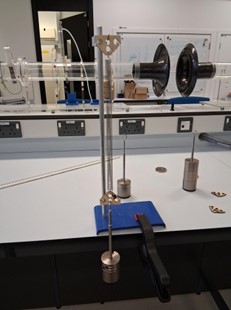
    In the thermodynamics laboratory, a 2nd-year exercise for Aerospace Engineering students involves investigating natural frequency using springs, masses, a ruler, and their phones as stopwatches. The session is open-ended: students decide the procedure within a clear aim, a loose brief, and examples of how to use the equipment.

    The equipment is normally prepared in advance so it is ready for students upon arrival. Previously, this activity ran seven times for 260 students in groups of 40, each session lasting 1.5 hours. This required 10.5 hours of contact time, plus seven rounds of setup and preparation.

    In the 25/26 academic year, this activity was scaled up and delivered in a flat teaching space with a capacity of 200. It ran twice, each time with 130 students working simultaneously (and the approach would permit up to 400 students without additional timetable demands).

    Observations

    To make the larger sessions manageable, students need to take greater responsibility for setting up and taking down the equipment, rather than relying on technical staff to do this in advance. While this requires clear instructions and uses some of the students’ learning time, it also increases students’ ownership of their experiment.

    There is also a noticeable increase in the energy of the environment. Smaller sessions can feel “flat”, but with over 100 students working on an activity in a single space, there is a strong “buzz” throughout the room.

    When running at this scale, careful consideration is needed when planning the degree of “scaffolding” provided to students. For efficiency, questions asked by students or common mistakes they can make can be anticipated and mitigated in the teaching material. For learning, it can be beneficial to engineer the session procedural speedbumps, to force students to consider what they are doing, why they are doing it and to initiate a conversation with lab staff. Addressing this tension is a delicate balancing act.

    The increased number of students in a single space will increase the possibility of students who have ASDs (diagnosed or not) becoming overwhelmed or having self-regulation issues that will impact their ability to engage with the lab activity or require them to leave. This would highlight the need to limit the number of students, so the extraneous cognitive load is kept to a manageable level.

    Finally, the model was shown to be more efficient in terms of GTA utilisation: not only were fewer GTA hours required, but it also allows for greater flexibility. With multiple small sessions, some groups will include students who need more support than others, leading to some sessions having sufficient GTA resources and others not enough. By combining students into a smaller number of sessions, these differences can be smoothed.

    When citing this work, please use the following citation:

    Garrard, A. Woolley, R. Brown, D. (2025). “Scaling Up Practical Engineering Labs for Teaching Spaces”. Centre for Engineering Education Blog, The University of Sheffield, Sheffield, UK. December 2025. https://ceesheffield.co.uk/2026/10/27/scalinguppracticalengineering/

  • Teaching with a Twist: Star Wars, Science, and Student Confidence

    Teaching with a Twist: Star Wars, Science, and Student Confidence

    In this blog, Marsya Ali profiles Dr Julian Dean, Senior Lecturer in Materials Science at the University of Sheffield and winner of the University’s Education Award for Teaching Practice in Engineering and Overall. The blog explores Julian’s approach to making engineering education engaging and accessible, from developing interactive virtual experiments through FlashyScience to using humour, creative examples and accessible language to help students understand complex concepts.

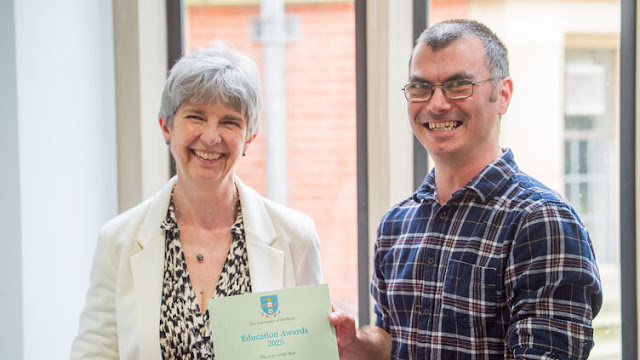
    When Dr Julian Dean was named winner of the University of Sheffield Education Award for Teaching Practice in Engineering and Overall, he described it as “really nice to be recognised.” But for Julian, a Senior Lecturer in Materials Science, the award wasn’t the goal. “I would have done [these things] without the award there,” he says. “It’s nice to know that it’s been seen as good practice.”

    Teaching Practice (Engineering) and Overall winner for teaching practice

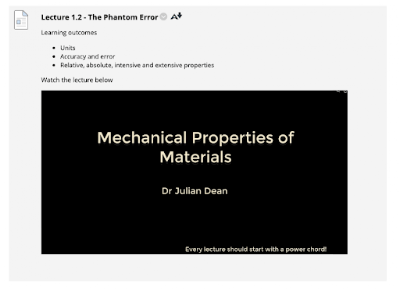
    That practice includes everything from playing a guitar power chord to open lectures, to giving lectures with titles like The Phantom Error. But behind the humour is a clear pedagogical goal: to create experiences that engage students on their own terms, whether that’s through themed worksheets, accessible language, or interactive virtual labs.

    Julian’s standout contribution, FlashyScience, exemplifies this approach. Co-developed as a virtual lab platform that enables students to experiment at their own pace, Dr Joanna Bates described it as “revolutionising learning and solidifying understanding in engineering and science.” Combined with his outreach work, visual storytelling, and ever-evolving use of digital tools, it’s no surprise Julian’s approach resonates—not just with students, but with colleagues across the Faculty.

    FlashyScience: A lab beyond the classroom

    FlashyScience began as a school outreach project, driven by a simple question: how far could you stretch students beyond the curriculum? Co-founded with Professor Dan Allwood, the idea grew from a series of in-person STEM sessions into a spin-out company offering fully interactive virtual experiments.

    Screen shot of a virtual tensile tester experiment set up from the Flashy Science website
    The FlashyScience virtual ‘tensile test’ experiment

    At the heart of FlashyScience is accessibility. Giving learners the chance to experiment at their own pace, repeat processes without risk, and explore concepts far beyond GCSE level. From simulating tensile testing to observing radioactive decay across decades, students can interact with complex ideas in a safe, self-guided environment. It’s used by schools and universities alike, including in Sheffield’s undergraduate teaching.

    For some students, the platform has helped build confidence, especially those who might otherwise hesitate in physical lab spaces. “This has allowed a completely flat playing field,” Julian says. “Everyone can do it in their own time, at their own pace… and they get a bit more confidence about that.”

    Making Lectures Memorable

    Julian’s lectures are anything but ordinary. From The Phantom Error to festive worksheets on Santa stuck in a chimney, his sessions weave engineering concepts into familiar pop culture and playful scenarios. “It’s just really silly,” he says, “but the students seem to love it.”

    presentation slide for mechanical properties of materials

    What started as a way to make sessions more engaging has become part of his teaching identity. During COVID, unsure how to begin recorded lectures, Julian decided to open each one with a guitar power chord—a choice that quickly became a student favourite.

    These elements aren’t just for show. They help students stay alert, connect with the content, and enjoy the learning process. “If you enjoy something, you’ll do it,” he explains—a principle that underpins his approach to making technical content memorable and accessible.

    Accessible Teaching: Simplified Language, Not Simplified Ideas

    Julian often uses simple analogies to make abstract concepts easier to grasp such as comparing atoms in a lattice to people holding hands: break the link, and the surrounding bonds might shift, redistribute, or even fall apart.

    This approach is especially useful for international students, who may be processing both scientific content and unfamiliar colloquialisms. By avoiding jargon, Julian ensures ideas remain accessible without being oversimplified, helping all students engage with confidence, regardless of background.

    Teaching That Thinks Like a Student

    Whether he’s building virtual labs or weaving pop culture into problem sets, Julian’s focus is always the same: thinking about how students learn best. “Not everyone learns in the same way,” he says. A reminder that accessibility and creativity aren’t add-ons, but core to effective teaching.

    That mindset is shaping what’s next. Starting this September and in partnership with the IOM3 and Discover Materials, first-year students in Materials Science will design their own outreach resources, from videos to podcasts, aimed at helping schoolteachers explain materials concepts. “They can pick five-year-olds if they really want a challenge,” Julian says. “Or 18-year-olds from college.”

    Students will choose everyday objects that interest them, from hockey sticks to climbing shoes, and link those to real-world materials science and school-level syllabuses. It’s part of a new collaboration with the Institute of Materials, Minerals & Mining (IOM3).

    It’s the same philosophy that runs through all of Julian’s work: teaching that meets students where they are, sparks curiosity, and gives them tools to go further.

    This is the first in a series of profiles of Engineering teaching staff at the University by Marsya Ali.

    When citing this work, please use the following citation:
    Ali, M (2025). “Teaching with a Twist: Star Wars, Science, and Student Confidence” Centre for Engineering Education Blog, The University of Sheffield, Sheffield, UK. July 2025.
    https://ceesheffield.co.uk/2026/10/29/teaching-with-a-twist-star-wars-science-and-student-confidence/

  • Let’s Talk Labs: Making Practical Learning Work for Everyone

    Let’s Talk Labs: Making Practical Learning Work for Everyone

    Ever felt like a lab session dragged on forever, or that you were just another face in a crowded room? A new study by Stephen Beck, Panos Lazari, and Matteo Di Benedetti from the University of Sheffield’s Faculty of Engineering has been exploring exactly that. Their research, published in the International Journal of Mechanical Engineering Education, sheds light on what truly enhances lab experiences for both students and staff. Their findings offer valuable insights worth considering.

    What Do Students Really Want from Labs?

    The team set out to understand how to make lab sessions more effective. They collected extensive feedback through questionnaires, focusing on two key aspects: the ideal duration of lab sessions and the optimal group size for collaboration. Their findings highlight a few crucial ways to improve lab organisation.

    Students in a Thermodynamics lab

    One of the most striking results was that students prefer shorter lab sessions. Just like attention drifts in lectures after about 20 minutes, lengthy lab sessions can lead to disengagement.

    The study suggests that two hours is the ideal maximum duration. Interestingly, students who enjoy labs are happy with the current length, while those who don’t would prefer shorter sessions.

    When it comes to group size, smaller is better. Both students and staff favour working in pairs. While some staff members find groups of three acceptable, students are less enthusiastic. The study found that groups of three tend to be less effective, possibly because one person may be left out. Groups of two or four seem to work best, likely depending on the experiment and equipment required. Notably, students who enjoy labs prefer smaller groups, while those who don’t tend to prefer larger groups. This highlights the importance of ensuring all students are actively engaged in the work.

    The Number of Labs: Quality Over Quantity?

    Surprisingly, most students are satisfied with the number of labs they have. Those who enjoy practical work would like more labs, while those who don’t would prefer fewer.

    Interestingly, some students who dislike labs still want more, possibly because they recognise their importance in engineering education. This suggests that the number of labs isn’t necessarily linked to whether students enjoy them.

    The study also highlights that group size should be flexible depending on the experiment and the level of the course. A one-size-fits-all approach may not be the best solution.

    What Does This Mean for Educators?

    It’s time to rethink how labs are structured. The key takeaways for educators are:

    1. Consider shorter lab durations, aiming for a maximum of two hours. Favour smaller groups, ideally pairs, but be flexible depending on the experiment.
    2. Ensure all students are actively engaged, avoiding group sizes where one person might be left out.
    3. Avoid reducing learning when reducing lab time or group sizes. Since lab duration and group size are resource-dependent, shortening sessions should be carefully managed to maintain educational value.

    Beck, Lazari, and Di Benedetti also examined ways to make lab time more efficient. One key recommendation is effective pre-lab activities to maximise hands-on time. Educators should also consider whether repetitive tasks are necessary and explore alternative methods like data pooling, allowing all students to fully participate. When expensive equipment is involved, a rotation system might be beneficial—letting one group use the resources while another discusses results with staff.

    The researchers even provide a practical equation explaining the relationship between lab duration, group size, and resource availability.

    The bottom line? Shorter labs with smaller groups can be just as effective as longer labs with larger groups while providing a better student experience.

    This study is a call to action for educators to rethink lab sessions, ensuring they are structured for maximum impact and engagement.

    You can check out the full paper by Beck, Lazari, and Di Benedetti here:

    Beck SB, Lazari P, Di Benedetti M. Lab group size and laboratory duration. International Journal of Mechanical Engineering Education. 2025;0(0). doi:10.1177/03064190251315693

    When citing this work, please use the following citation:
    Beck, S. Di Benedetti, M (2025). “
    Let’s Talk Labs: Making Practical Learning Work for Everyone” Centre for Engineering Education Blog, The University of Sheffield, Sheffield, UK. February 2025.